Blog
Iran war costs US households $860 more in gas prices, economist says
Moody’s Analytics Chief Economist Mark Zandi says the Iran war has caused prices for gas, diesel and jet fuel to surge, with consumers paying over $100 billion more since the war began.
American consumers are facing higher costs as the war in Iran pushes energy prices higher, with U.S. households having spent over $100 billion more this year due to elevated gasoline and diesel prices, an economist says.
Mark Zandi, chief economist at Moody’s Analytics, told FOX Business that “higher oil prices and energy more broadly” have been the main economic consequence of the Iran war felt by U.S. households.
“The war has added about $115 billion in additional costs through higher gasoline prices, what we pay at the pump; diesel that goes to everything that’s put on a truck from groceries to Amazon packages; and jet fuel. So, if you fly in an airplane, you can pay more because you have to pay for the cost of that fuel,” Zandi said.
“If you add that all up, it’s about $115 billion. And if you divide by the number of households, that’s about $860 per household. So, a typical household is spending $860 more on energy than they otherwise would have if there had been no war.”
AMERICANS FACE THE MOST EXPENSIVE LABOR DAY AT THE GAS PUMP EVER RECORDED
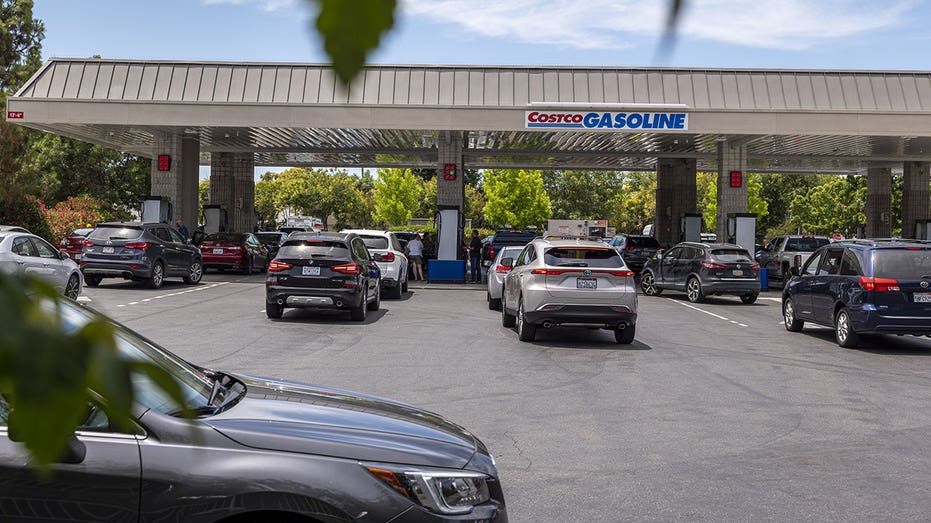
American consumers have spent about $115 billion more this year due to the rise in energy prices amid the Iran war, Zandi said. (David Paul Morris/Bloomberg)
The war’s impact has hit lower- and middle-income American households the hardest. Zandi said that higher-income households have been better able to digest the higher energy costs.
“Folks that are in the top part of the income and wealth distribution, the well-to-do, they’re doing fine. They’ve got a job. They don’t have much in the way of debt. If they have any debt, it’s a mortgage that’s sitting on a very low interest rate, they own a lot of stocks and benefit from the run-up in stock value,” Zandi said.
“For lower- and middle-income Americans, it’s tough, much more difficult. Their incomes on an after-inflation basis because of the war have come to a virtual standstill, and some are actually declining. Those folks, they don’t own much stock, they may not even own a home and they have a fair amount of debt. So, they’re struggling, and the high energy costs — the fact that we’re paying over $4 a gallon — it really matters to those folks,” Zandi said.
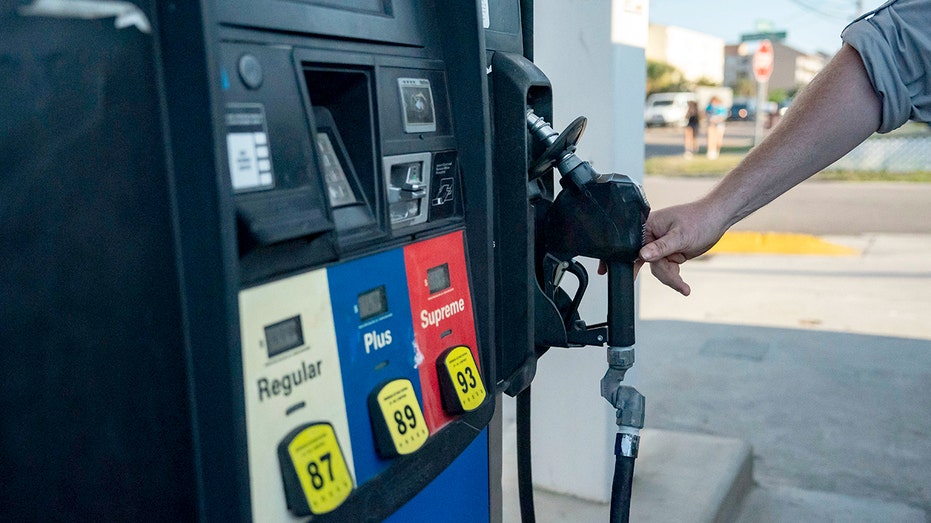
A driver reaches for the pump at a gas station in Carolina Beach, N.C., July, 1, 2026. (Allison Joyce/Bloomberg via Getty Images)
NATIONAL AVERAGE PRICE FOR DIESEL HITS NEW RECORD HIGH AMID IRAN CONFLICT
Inflationary pressures have persisted in the economy since the COVID-19 pandemic and the pace of price growth picked up again this year due to the energy shock caused by the Iran war. Zandi noted that households were better able to deal with higher gas prices earlier this year after larger tax refunds, though their effect has diminished over time.
“Some of the ill effects of the Iran war on consumers were mitigated early on in the year because of the tax cuts,” he said. “People got bigger tax refund checks this year than last year because of the One Big Beautiful Bill Act. That helped up and through probably May, maybe into June, but those tax cuts are now in the rearview mirror, so households are still stuck paying over $4 a gallon.”
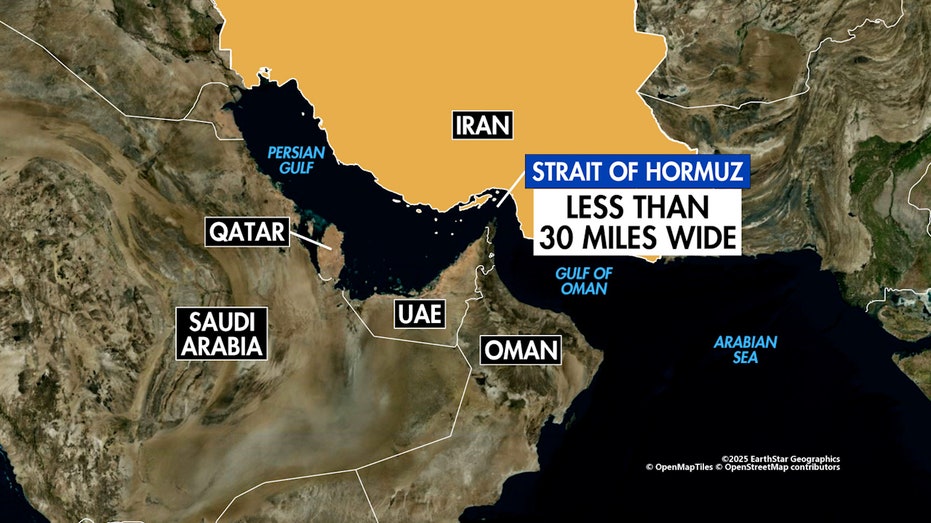
About 20% of the world’s oil supply crosses the Strait of Hormuz off the coast of Iran. (FOX)
The Iran war has constrained the flow of oil through the Strait of Hormuz due to the threat of Iranian attacks and sea mines in the main shipping channels through the narrow waterway. While the U.S. Navy has escorted vessels through the choke point and countries bordering the Persian Gulf have utilized alternative means of transporting oil, including pipelines, oil supplies haven’t recovered to their pre-war level.
“The only relief is if the war winds down, at least in the sense that more oil flows through the Strait of Hormuz. That’s still very much a bottleneck. Oil tanker traffic is still well, well below what it was before the war started,” he said.
“Ultimately, we’ll figure it out. The oil that doesn’t go through the strait will find other ways to get into the global marketplace, pipelines and other things. And we’ll see more production in the rest of the world because you can make a lot of money now producing because prices are so high,” Zandi explained.
“That’ll happen, but that takes time. That’s not next week, next month, next quarter, may not even be next year.”
TREASURY YIELDS HOVER NEAR MULTI-YEAR HIGHS AS ENERGY PRICES AND GOVERNMENT DEBT FUEL BOND SELL-OFF

Vessels transit the Hormuz Strait off the coast of Iran’s southern port city of Bandar Abbas Sept. 7, 2026. (Atta Kenare/AFP via Getty Images)
Zandi said that while oil prices would likely start to decline when there’s an indication that supplies are normalizing, he cautioned they’re unlikely to return to pre-war levels in the foreseeable future, in part due to the drawdown of reserves.
“I don’t think they go back to where they were pre-war because, in most scenarios, you still have to worry about the conflict restarting and the strait being shut down again. Insurance companies will demand a higher premium to pay for the risk of insuring tankers that go through the Persian Gulf,” Zandi said.
“It will take some time to restore all the inventory drawdown that has occurred,” he added, noting the moves by the U.S. to release oil from the Strategic Petroleum Reserve and those by other countries like China and India from their own reserves.
GET FOX BUSINESS ON THE GO BY CLICKING HERE
“That’s helped cushion the blow, but we won’t get back to normal, if that’s the right word, for some time until those inventories are replenished and that could take a while,” Zandi said.
#Iran #war #costs #households #gas #prices #economist