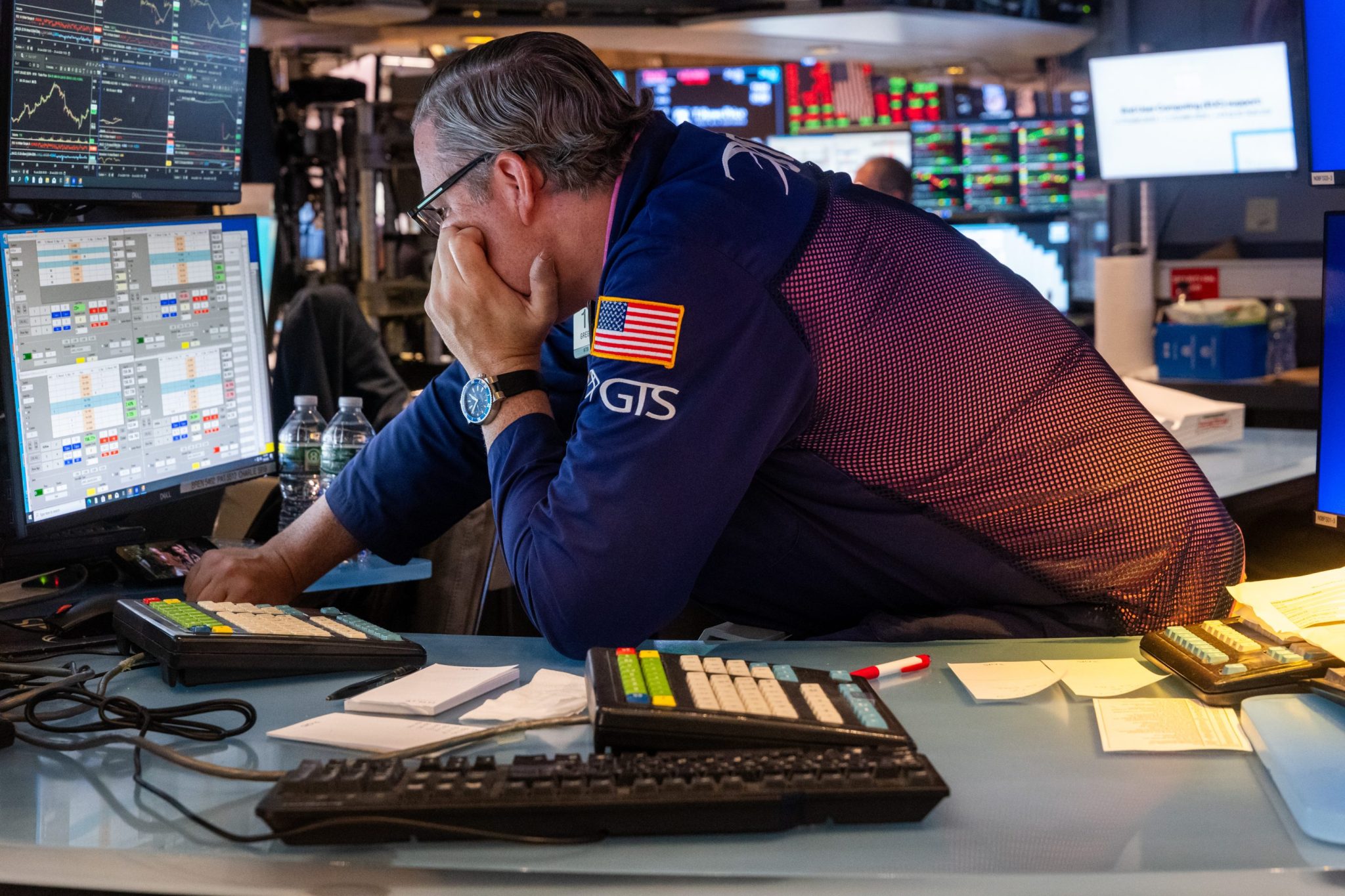
The one-way trade in semiconductor stocks that has defined equity markets this year is coming unglued, triggering stomach-churning volatility as investors grow increasingly concerned that the fire-hose of artificial intelligence spending won’t continue.
The Philadelphia Stock Exchange Semiconductor Index, or SOX, plunged 21% in July for its worst month since October 2008, the midst of the global financial crisis. On nearly half the trading days last month, the index, which tracks 30 of the world’s biggest chipmakers, closed up or down by least 4%. And all 22 sessions had intraday swings of at least 2%, something that hasn’t happened since 2020.
“The volatility really speaks to the level of general uncertainty and how no one knows how this is going to play out,” said Stephen Evans, chief investment officer at Pave Finance.
“I think the cycle still has a way to go, and that investors can stay long,” he added. But “you have to be able to stomach a Disney World kind of ride.”
Much of the volatility is a result of greater scrutiny being placed on big-tech capital expenditure plans, casting doubt on the sustainability of the spending. Add in growing competition and the proliferation of open-source AI models — which can be cheaper and more efficient to run, requiring less infrastructure — and investors are starting to question whether the best days for chip stocks may already be in the past.
Even after a two-day 8.3% rally to end the month, the SOX is still down 23% from its record high hit on June 22. Every stock in the index is in the red over that stretch, and more than half have lost at least 25%.
Some investors think the selloff has become so extreme that it has created a short-term dip buying opportunity. Over the longer-term, however, the prospects for chip stocks is dicey.
“It wouldn’t surprise me if, after this selloff, we saw a pretty solid bounce from chips, but I think it is unlikely that they will lead the next leg of the bull market,” said Charles Lemonides, chief investment officer at Valueworks. “They’ve had their day in the sun.”
Fallout from the swift decline in stocks across the AI landscape in July has already begun to rear its head. Situational Awareness, the hedge fund led by Leopold Aschenbrenner, was forced to sell billions of dollars of tech shares to meet margin calls after those bets rapidly lost value. The fund had been an investor in companies tied to the AI boom, including semiconductor maker Sandisk Corp., which lost almost half its value in July after soaring 858% in the first half of the year.
Obviously, with those kinds of gains, investors are taking profits in stocks that have doubled, tripled or even quadrupled this year. But the stark shift in investor enthusiasm is an indication of the growing skepticism about the central thesis that had powered the rally.
Still, the industry’s growth outlook over the coming year remains rosy, with analyst calling for earnings to continue to balloon at firms like Nvidia Corp. and Broadcom Inc. Last week, Amazon.com Inc. and Microsoft Corp. reaffirmed their commitments to spending hundreds of billions of dollars on AI over the next year alone, with much of that cash earmarked for the makers of chips used in data centers.
Read More: Amazon, Microsoft Show That AI Spending Spree Remains Solid
The problem is the fundamental picture beyond that is coming into question. Chip stocks, particularly those that specialize in memory, are notoriously cyclical, with regular booms and busts based on rising and falling demand. And many on Wall Street remain steadfast in their belief that this cycle won’t be any different.
“The earnings explosion we’ve seen is just not sustainable,” Valueworks’ Lemonides said.
“The bigger question is whether margins can be sustained,” he added. “Margins are so out of sync with historic norms that it is reasonable to expect them to come in. The question is when, and what stocks do about it.”
A gauge of realized volatility for the SOX over the last 60 days has soared to its highest reading since the start of the Covid pandemic. The only other time it reached a similar level in the last two decades was during the global financial crisis.
The July selloff erased $2.2 trillion from the SOX’s market capitalization. Particular losers included American depositary receipts of Taiwan Semiconductor Manufacturing Co., which fell 15% in July, erasing more than $380 billion in market value. The company raised its spending and revenue outlooks in the middle of the month.
TSMC was followed by Micron Technology Inc., where a 29% drop — its steepest monthly drop in more than a decade — erased $374 billion in valuation.
Finally, Intel Corp. sank 35% over the month, erasing about $247 billion. Intel’s monthly drop was its biggest since September 2000.
In a reflection of how divergent chip performance has been, some major names rose over the month, including Nvidia and Broadcom.
The volatility in chip stocks was met with a historic level of activity from retail traders, according to Bloomberg Intelligence. Individual investors poured a record $12 billion of net inflows into semiconductor-related exchange-traded funds in the last week alone.
“Semiconductor ETFs have never seen this level of activity in either flows or trading volume,” BI analyst Eric Balchunas wrote. “The $12 billion of inflows wasn’t only a record, but also accounted for 25% of net inflows into all ETFs over the past five days, even though semiconductor ETFs represent just 1% of total ETF assets.”
A fund dedicated to memory chipmakers as well as a triple-leveraged semi fund saw particular interest.
#Wall #Streets #favorite #bet #undone #chips #whipsaw #market