➡️ Did someone forward you this email? If you would like to receive this information directly, every morning before the markets open in New York, sign up here.
IT’S ALL A BIG MISUNDERSTANDING!
OpenAI says ‘Apple is getting this wrong’
Apple’s lawsuit against OpenAI, in which the iPhone company claims OpenAI staff stole its trade secrets, is based on a series of comical misunderstandings, OpenAI said in a blog post yesterday titled “Apple is getting this wrong.”
“Apple had claimed that they contacted OpenAI in February and that we didn’t respond,” OpenAI said. “They now admit that their outside lawyers emailed the wrong person after confusing two Asian last names—only after we brought this to their attention. Apple also claimed they had a discussion with our General Counsel, which they now concede never happened.”
Sam Altman’s company also complains that the ex-Apple staff who work for him only accessed Apple information after they left the company because Apple asked them to, after it failed to access the files in their absence. Read the whole thing—including the text messages and emails—here.
ONE BIG THING
Ukrainian soldiers have business-like KPIs for killing Russians—and they’re working, RAND says
Russia’s war on Ukraine has become a grinding tally of raw numbers, and Kyiv is executing its strategy with the ruthlessness of a corporate efficiency expert, according to the RAND think tank.
In a note last month, researchers Gian Gentile and Andrew Radin pointed out that Ukraine has gained the upper hand via attrition: wiping out more of an opponent’s troops and weapons than you lose.
Russia, of course, has a larger population and military than Ukraine. So Kyiv has opted for a simple, albeit grim solution: kill Russian soldiers faster than they can be replaced, according to Gentile and Radin.
Ukraine has KPIs for the military—just like corporations, which use them to track output from employees or subsidiaries.
Ukraine’s KPIs call for killing 200 Russian troops for each square kilometer of territory seized and eliminating at least 50,000 each month. It includes an “ePoints” competition, thought to be the first of its kind anywhere, in which drone operators are awarded points for high scores on the battlefield.
THE MARKETS
Stocks rally across the globe as the price of oil declines
- S&P 500 futures were up 0.13% this morning. The index rose 1.48% yesterday.
- In Europe, the Stoxx 600 was up 0.37% in early trading and the U.K.’s FTSE 100 was up 0.19% before lunch.
- Asia: South Korea’s KOSPI was up 1.62%. Japan’s Nikkei 225 was up 0.32%. India’s Nifty 50 was down 0.64%. China’s CSI 300 was up 1.27%.
- Brent crude was $85 per barrel this morning up from a low of $82 yesterday.
- Bitcoin was $63.4K.
MORE FROM FORTUNE
From Porsche penthouses to Nobu lofts: Inside the $67 billion boom in luxury branded residences – Zahra Tayeb
The NFL’s previous push into Europe lost $400 million. Why it’s trying again – Sam Birchall
OpenAI’s Greg Brockman gave $5.5 million to protect the home of an internet-famous bald eagle named Jackie – Sydney Lake
How Zohran Mamdani’s pied-à-terre tax exposed an epidemic of ‘ghost cars’ instead – Catherina Gioino
Ray Dalio on the AI bubble nearing 1929, 2000 levels and the lesson people always forget: ‘wealth is not the same as money’ – Nick Lichtenberg
The AI race isn’t about models, it’s about infrastructure—and the U.S. is still far ahead – Alex Capri
NOT A BUBBLE
In epic earnings call, Palantir’s Karp—pounding the table—says ‘people finally believe us’
When it was Alex Karp‘s turn to speak on Palantir’s second-quarter earnings call Monday evening, the CEO could barely contain his excitement. Grinning as he repeatedly pounded his pen on the table—and taking jabs at unnamed Silicon Valley AI competitors who “eat vegetables” and don’t support the U.S. military—a pugnacious Karp reveled in what he saw as a landmark moment for the AI software company and a vindication of its approach of selling customized AI services to businesses.
“Obviously, we are loving these results and loving what they mean for our customers and, broadly speaking, the West,” Karp said.
In the quarter ended June 30, Palantir delivered one of its strongest quarters yet. Revenue surged 93% year over year to $1.94 billion, easily topping analysts’ expectations of $1.801 billion. The company reported net income of roughly $1.1 billion, or 41 cents per share, ahead of Wall Street’s estimate of 35 cents.
AI
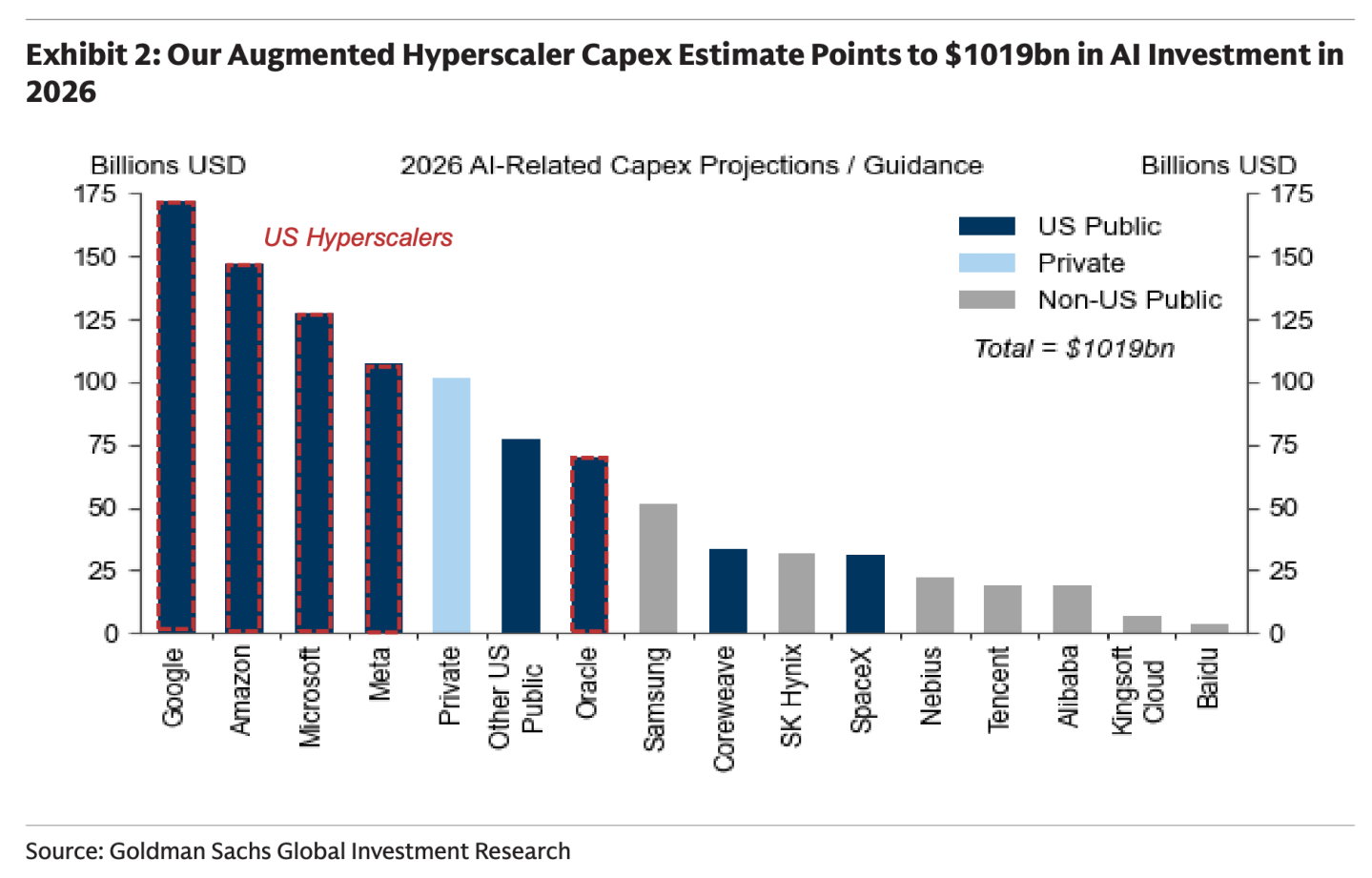
$1 trillion in AI capex coming down the pipe this year …
A much, much larger amount of money than previously estimated will be invested in AI this year, according to Joseph Briggs and Sarah Dong of Goldman Sachs: $1.019 trillion globally and $581 billion in the U.S. That is such a staggeringly large amount that it will shift U.S. and global GDP upward by nearly 3% at the high end. “AI capex will rise from 1.8% of GDP in the U.S. (0.9% globally) in 2026 to 2.5% of GDP in the U.S. (1.3% globally) in 2027, with a further increase to 2.8% (1.4% globally) in 2028,” they said in a note.
… Not all of it wanted
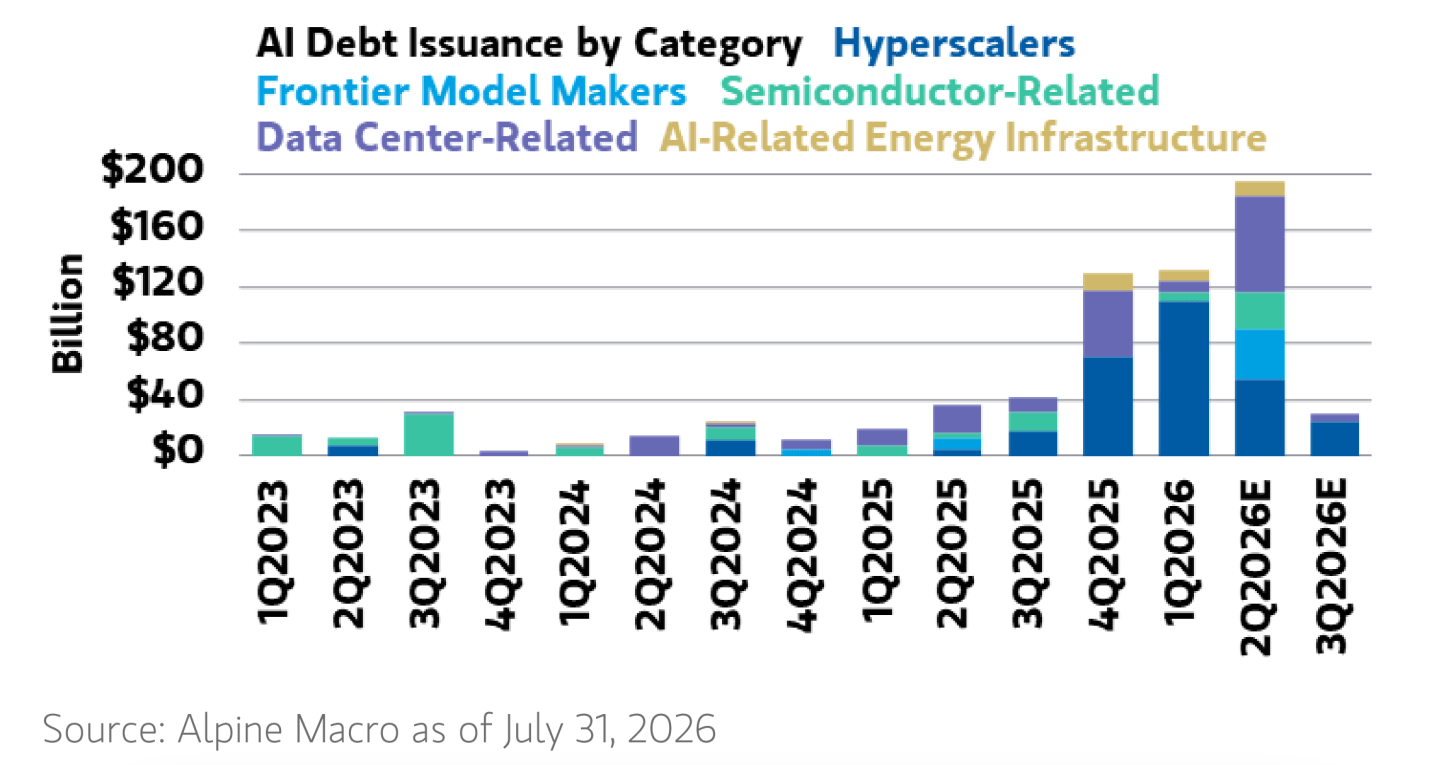
Over at Morgan Stanley, they’re worried about the quality of the debt issued to support all that spending. The credit market is demanding higher yields on AI-related debt, even when it is coming from investment-grade companies. “Hyperscaler debt is pricing at yields roughly 5–10 basis points wider than the median investment-grade issue despite higher ratings, and lower-quality debt is a full 30 basis points wider amid renewed questions about circular financing,” Lisa Shalett and her team said in a note seen by Fortune.
“[Debt] issuance has also turned a bit more chaotic, with two surprise $25 billion deals from players tangential to the ecosystem. This indigestion is not only driving relative underperformance for the sector within [investment-grade debt] but raising debate around cash flows.”
IRAN
Iran and Oman may be carving Trump out of the deal he wants for the Strait of Hormuz
No one knows what is really going on between President Trump and Iran. Yesterday, the president said he had called off a round of attacks because the Iranians had asked for talks. By the end of the day, Trump had called Tehran “duplicitous” and admitted that no talks had taken place.
Trump did say that Iran and Oman were discussing a deal to handle the Strait of Hormuz. That opens the prospect of both countries reopening the Strait by charging fees for shipping, without the consent of the U.S. That would give the White House the uncomfortable choice of either leaving the Strait in the hands of Tehran (which would at least bring down the price of oil and restart export commerce in the region) or use its naval blockade to target ships trying to pass through.
Last night, Trump told reporters, “This is a last chance for them to sign a good document” that would end the conflict, and he said talks are “going on right now” with various mediators.
For its part, Iran has repeatedly insisted it is not talking to the U.S.
Meanwhile, a Liberian ship in the Strait was struck by an unidentified missile and traffic through the seaway remains very low.
NUMBER OF THE DAY
77%
The percentage of S&P 500 companies that beat expectations among the 307 that have reported Q2 earnings so far. “The EPS beat rate is at its highest level since 2021,” according to Bank of America’s Savita Subramanian and Victoria Roloff.
THE FRONT PAGES TODAY
Revolut chief Nik Storonsky sued by broker over €350mn superyacht – FT
BP profit more than doubles as Trump blasts Big Oil for ‘making too much money’ – CNBC
Cyclospora outbreak causes first two deaths – Axios
The AI Boom Is Transforming the American Economy Beyond Recognition – WSJ
SpaceX’s First Earnings Offer a Chance to Reverse Stock’s Plunge – Bloomberg
A Currency Trader at Heart, Bessent Bets on Japan’s Yen – NYT
ONE MORE THING
What if SpaceX’s much-criticized corporate governance is good for investors?
SpaceX reports its first-ever post-IPO quarterly earnings tonight, and on August 6 the company’s insiders and employees will be freed from the lockup period that prevents them from selling their stock. That might not offer them much comfort, as the stock opened at $114.53 this morning, down 15% from its IPO price of $135.
Elon Musk’s company has been slated by corporate governance critics. They say that the fact that Musk controls 80% of the stock’s voting rights and is the CEO, CTO, and board chairman is “catastrophic,” according to one Danish pension fund. Nell Minow, the veteran corporate governance observer, said SpaceX’s IPO “extinguishes shareholder rights entirely, all but eliminating the right to bring a lawsuit for failure to meet fiduciary standards.”
But over at Jefferies, analyst Aniket Shah advises investors to ignore all that.
“The data is clear that there is no clear direct evidence that chairman-CEO separation always leads to better performance,” he told Bloomberg. “A check-list approach where dual-class shareholder structure is bad, chairman-CEO separation is good, shareholder concentration is bad — is overly simplistic and can result in making bad investment decisions.”
Anyone following those rules would have been prevented from investing in Facebook or Tesla, he noted.
Still, the stock has been hammered by traders since it went public. It was once worth $201 per share but is now trading at just 55% of that value. Maybe Musk can turn it around tonight. Some traders think he can: The stock rose 5.68% yesterday and rose another 2% overnight.
#Sam #Altmans #OpenAI #publishes #brutal #critique #Apple #lawsuit #Apple #wrong