➡️ Did someone forward you this email? If you would like to receive this information directly, every morning before the markets open in New York, sign up here.
ONE BIG THING
The irony of Iran’s plan for tolls on the Hormuz: They might be cheaper than you’d think
If Iran got its way and imposed shipping tolls on the Strait of Hormuz at around 5% to 7% of each oil cargo, it might generate close to $20 billion a year for the regime in Tehran, Fortune’s Jordan Blum estimates. But such astronomical tolls won’t be accepted by the U.S. or Iran’s Gulf neighbors, geopolitical and energy analysts say.
That means the stalemate will drag on indefinitely or Iran will eventually accept a lesser, but still substantial, financial payout. Either way, the Middle East and, as a result, global energy markets are forever changed.
The ironic thing: If Iran sets a price too high, the Gulf countries will be forced to adjust and export their oil over land, thus rendering the Strait irrelevant. And the Iranians likely understand that they would have to keep the fees low enough to be economically viable.
“The strait is never going to go back to its pre-war status quo,” said Gregory Brew, senior analyst for Iran and energy with the Eurasia Group. “There’s going to be a permanently recognized Iranian role in managing the waterway.”
“An unattractive deal with Iran is the best of limited bad options,” he believes.
THE MARKETS
Global stocks stage mini rally on buoyant AI earnings
U.S. tech stocks largely fell yesterday with the Nasdaq Composite losing 0.6%. But AI cloud provider CoreWeave published blockbuster Q2 results and markets in Asia and Europe woke up with a smile this morning.
- S&P 500 futures were up 0.22% this morning. The index was down 0.32% yesterday.
- In Europe, the Stoxx 600 was flat in early trading, as was the U.K.’s FTSE 100.
- Asia: South Korea’s KOSPI was up 3.68%. Japan’s Nikkei 225 was up 0.83%. India’s Nifty 50 was down 0.55%. China’s CSI 300 was up 0.58%.
- Brent crude was $88 per barrel this morning.
- Bitcoin was $63.8K.
At CoreWeave, $3 billion in insider sales since the IPO
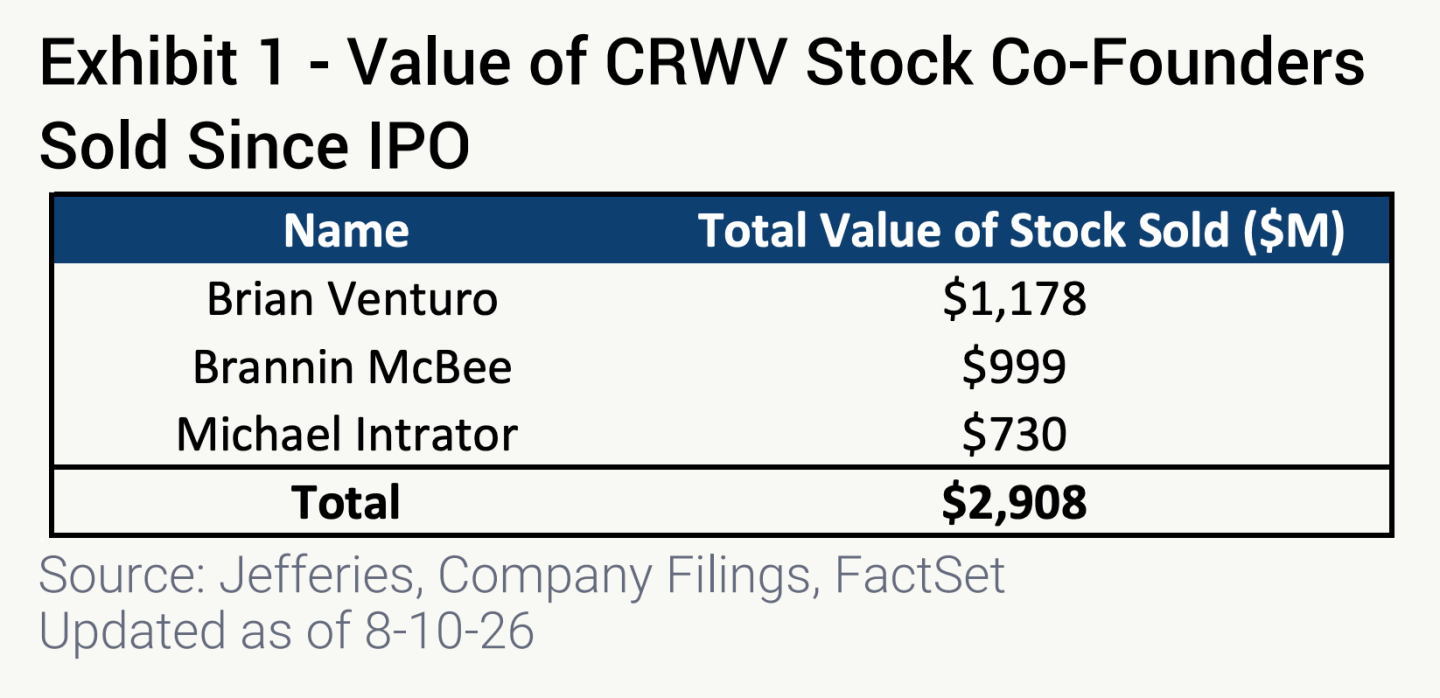
CoreWeave—an AI cloud computing company—disclosed in its Q2 earnings last night that it more than doubled revenue. But the company’s disclosures to the SEC also contain this eye-popping fact, spotted by Brent Thill and colleagues at Jefferies: “Since CRWV’s IPO [March 2025], the firm’s co-founders have sold ~$2.9B of CRWV stock through 10b5-1 trading plans.” A Rule 10b5-1 plan lets insiders schedule sales in advance, while they aren’t holding material nonpublic information, so later sales can’t be second-guessed as insider trading. Investors didn’t care: The stock rose 2.42% before the close yesterday and then another 17.4% premarket. Here’s the chart:
Incoming: CPI inflation expected to be soft, keeping the Fed on hold
We will get a new consumer price index (headline inflation) today from the U.S. Bureau of Labor Statistics. The expectation is for a “soft” number around 2.5%—which would tempt the Fed to keep interest rates on hold again in September. “Today’s U.S. July consumer price inflation data will be less precise than in the past. There are more gaps in the data, and those gaps are filled by (educated) guesswork,” UBS’s Paul Donovan advised clients this morning. “The reaction to a single weaker employment report shows the potency of any data release at the moment.”
“Absent the war, that figure would likely be at or near 2% (core inflation has embedded energy in freight costs, air fares, etc.). One year on, tariff effects should add less to the inflation rate,” he said.
European stocks are doing surprisingly well
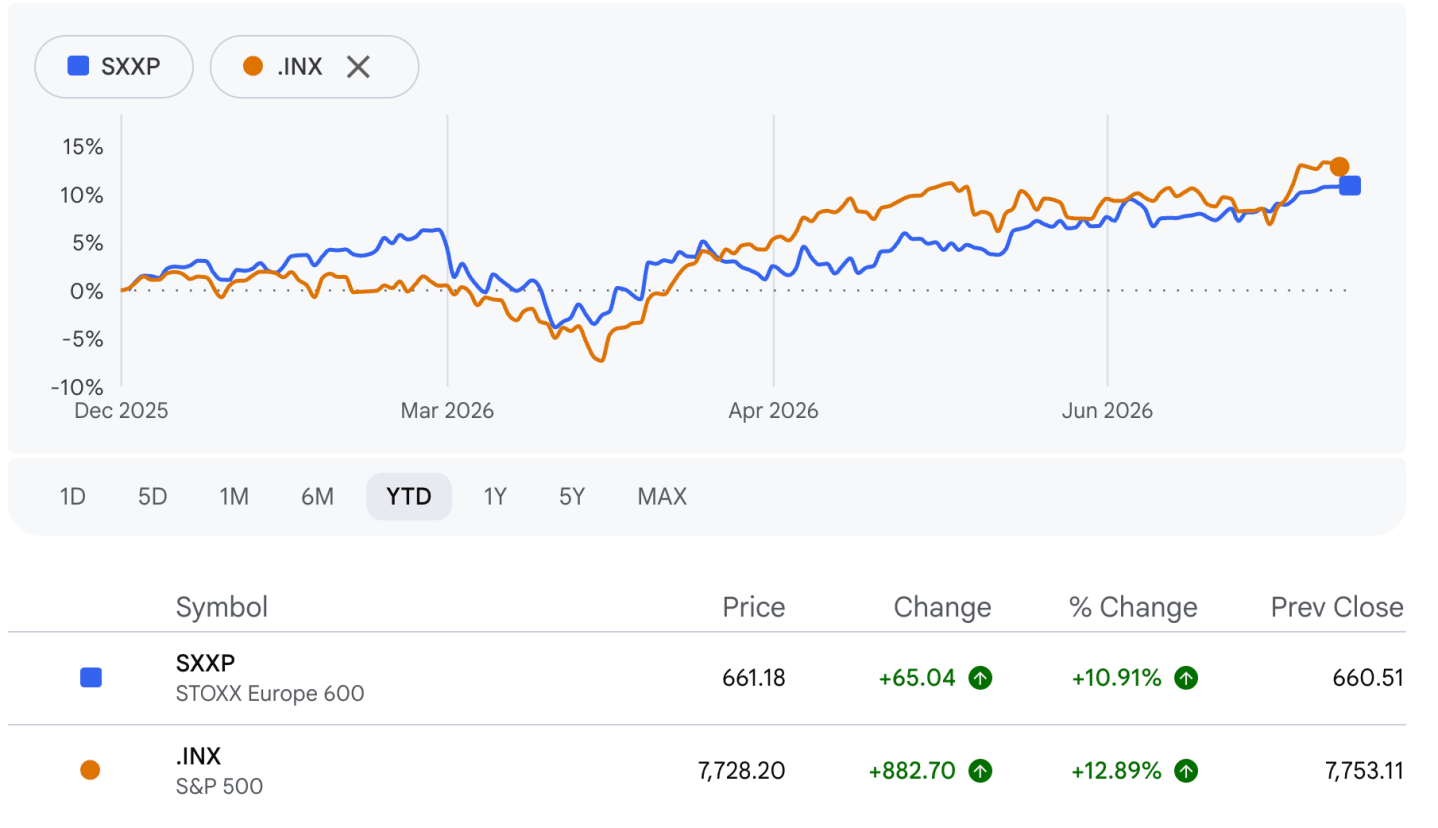
One of the “myths” about European companies is that they underperform on profits and are particularly exposed to the oil supply shock from the Gulf, according to Sharon Bell and her team at Goldman Sachs. But that is not true this year, she said in a note. “The prevailing narrative that Europe is struggling to generate earnings growth is increasingly at odds with the data. First-half EPS growth is tracking at +14% y/y, the strongest pace in three years, and notably comes despite a renewed energy supply shock, which has historically been viewed as a headwind for European earnings.” The Stoxx 600 is up 11% year-to-date, comparable to the S&P 500’s 13%.
MORE FROM FORTUNE
Universities are buying and selling property for data centers, prompting concerns about an AI brain drain – Joshua Hong
Meet ChatTJB, the “AI” chatbot with no AI, no algorithm and no LLM. It’s just one guy and 10,000 volunteers typing back – Tatiana Sataua
Forget the gala, these Silicon Valley schools run their own venture capital funds – Amanda Gerut
When OpenAI employees have a problem, they email this special address to see if Sam Altman will solve it immediately – Emily Forlini
France hits unsolicited telemarketers with $87,000 fine per call, following similar provisions in other European nations – Joshua Hong
CHART OF THE DAY
The U.S. housing market is stuck in a rut
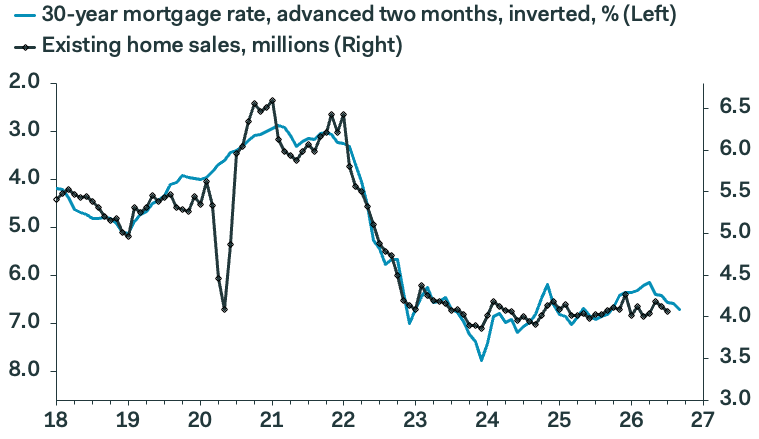
Sales of existing homes in the U.S. dropped to 4.06 million in July, down from 4.13 million in June. That’s not good, according to Pantheon Macroeconomics’ Oliver Allen: “The further dip in sales leaves them in the middle of the depressed range they have been stuck in for around three years now, and around a quarter below their average level in the five years leading up to the pandemic,” he said in a note.
“Looking further ahead, a significant housing market recovery is unlikely, as long as monetary policy remains relatively tight, the labor market subdued, confidence depressed, and population growth constrained by tighter immigration policies.”
NUMBER OF THE DAY: Humanoid robots
90%
The percentage of the global “humanoid” robot population controlled by Chinese companies, according to research from the energy consultancy Wood Mackenzie. For instance, State Grid Corporation of China (a utility company) “has committed US$1 billion in 2026 to procure 8,500 AI-enabled autonomous robots across more than 600 specialized tasks, signalling that robotics has become critical national infrastructure,” Wood Mackenzie said in a statement.
THE FRONT PAGES TODAY
JD Vance asked Ukraine to halt strikes on tankers using Russian port – FT
World’s largest sovereign wealth fund posts record $184 billion profit as it reveals SpaceX stake for the first time – CNBC
Tech companies propose tracking rogue AI agents – Axios
Why Wall Street and Nvidia are building an exotic money pipeline for the AI Boom – WSJ
Bessent-Takaichi divide on optimal BOJ path threatens yen rescue – Bloomberg
Paramount has spent 100 years in Hollywood. David Ellison loved that. Until he didn’t – Hollywood Reporter
Kroger to close 60 ‘underperforming’ stores – NY Post
ONE MORE THING
Climate change threatens Italy’s $4.7 billion ‘cheese banks’ that hold wheels of Parmigiano as collateral
In the hills of Emilia-Romagna, a bank vault holds more than half a million wheels of Parmigiano Reggiano, worth well over 300 million euros. The vault belongs to the bank Credito Emiliano, which has accepted young wheels of Parmigiano Reggiano as collateral for loans to dairy farms since 1953.
But now, extreme heat is threatening Italy’s “cheese banks,” Fortune’s Cat Gioino reports.
Thanks to this year’s record heat waves in Europe, energy consumption rose about 30%, forcing the bank to upgrade cooling systems and boilers, add insulation, and expand renewable power generation.
And because it’s so hot outside, cows lie down more and eat less, reducing milk production by up to 10% a year. Longer and more intense heat events hit the quantity and quality of milk, ultimately driving up costs that may not show up in the supply chain until months later.
#unattractive #deal #Iran #limited #bad #options #oil #flowing