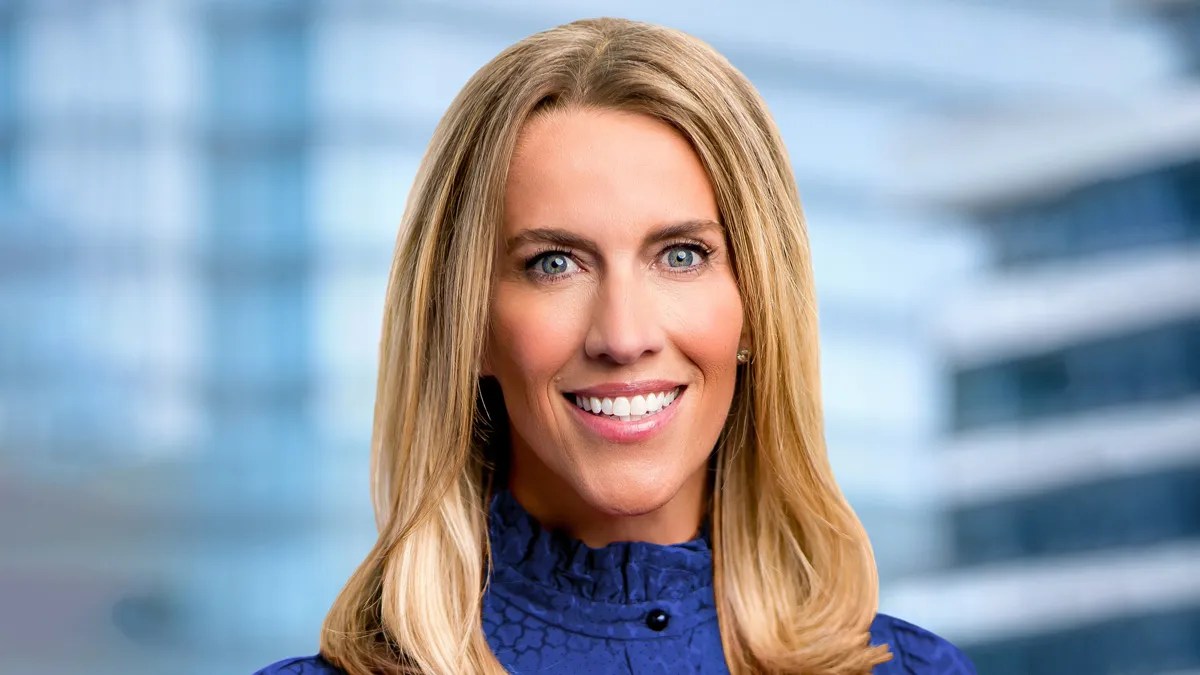
When Kellyn Smith Kenny joined AT&T as CMO in November 2020, she joined a company whose identity was about to change dramatically.
AT&T had spent years expanding into entertainment, including its $85 billion acquisition of Time Warner, and owned satellite television provider DirecTV. By the time Kenny arrived, that strategy was giving way to a retrenchment that would return AT&T’s focus to its telecommunications business. The company would separate DirecTV and eventually spin off WarnerMedia, while directing more capital toward 5G and fiber and reducing debt.
Kenny saw an iconic company that, in her words, had “lost its way a bit” and needed to find its “swagger again.” That complexity was part of the attraction. Kenny, whose career had taken her through Microsoft, Capital One, Uber, and Hilton, wanted her next job to be at a company where marketing would play a central role in its transformation.
“I’m only going to go to a company where, for that company to truly reach its full potential, marketing has to be a key ingredient,” Kenny recalls of her thinking at the time.
Nearly six years later, the CMO, who also serves as AT&T’s chief growth officer, says the company can quantify how brand strength translates into customer growth.
One measure AT&T tracks is what Kenny calls “brand love,” measured by asking consumers to rate brands on a seven-point scale running from hate to love. AT&T counts respondents who select either of the two highest ratings, a six or seven, as consumers who love the brand.
AT&T’s brand love score has risen 13 points over the past five years, according to Kenny, who says a one- or two-point increase in a year is typically considered strong performance.
The more consequential finding came when AT&T compared those survey responses with subsequent customer behavior.
Prospects who say they love AT&T are 1.6 times more likely to become customers within the following 12 months, according to the company’s analysis. Existing customers who love AT&T are three times less likely to leave and roughly 50% more likely to buy a second service, such as adding fiber to wireless. In markets where AT&T records higher levels of brand love, converting prospects into customers costs roughly 50% less, Kenny says.
The analysis gives AT&T a way to tie an often nebulous measure of brand sentiment to hard business outcomes, including customer acquisition, retention and spending.
“We wanted to sharpen our pencil and make sure that we understood exactly what the financial impacts are,” Kenny says, adding that understanding consumer sentiment is “essential for the core economics of the company.”
Turning customer research into products
Kenny’s remit as chief growth officer also puts marketing closer to AT&T’s product and growth strategy. As head of growth, she oversees customer research, insights, and analytics, as well as digital, and her team’s work informs product roadmaps and broader operational strategy across AT&T.
Case in point: AT&T found that roughly 40% of consumers are extremely price sensitive, Kenny says, either because of financial constraints or because they prefer to pay only for what they use. Some felt they were paying for extras they did not want, such as entertainment services and international calling, even when those features were advertised as free.
That insight helped shape AT&T’s Build a Plan offering, which starts at $15 a month and lets customers add the services they want. The offering targets consumers who viewed AT&T as too expensive because its plans included services they did not value.
The same customer research has also shaped how AT&T handles service failures. The company found that customers wanted greater confidence in the reliability of its network and customer support, helping lead to the AT&T Guarantee. Under the guarantee, eligible fiber customers who experience an outage of at least 20 minutes receive a full day’s service credit.
AT&T also commits to resolving certain technical issues within 24 hours and compensates customers when service falls short of its standards. The program followed a roughly $1 billion investment in customer service and technology improvements that allow AT&T to detect outages, notify customers, and issue credits proactively, says Kenny.
Moreover, she says, her data shows that customers who have experienced the guarantee after a service problem report higher satisfaction with AT&T than customers who have not had an issue.
The guarantee also gives AT&T another point of differentiation in a telecom market where competitors make similar claims around coverage, speed, reliability and price, says Kenny.
Marketing infrastructure customers rarely see
One of Kenny’s biggest marketing challenges is explaining the value of infrastructure customers rarely notice when it works as intended. For most consumers, the network shows up as reliable connectivity, while the technology that makes it possible remains largely invisible.
AT&T is trying to make those investments more tangible by alerting customers when connectivity in their area has improved, their home internet speeds have increased, or coverage along their commute has expanded.
FirstNet, the nationwide public-safety broadband network AT&T operates for first responders, is one way the company translates its infrastructure into a more concrete benefit.
AT&T has found that mass-media advertising for FirstNet improves perceptions of the brand even among consumers who are not first responders and cannot use the service. Knowing that firefighters, EMTs, and other emergency personnel have priority connectivity during crises gives those consumers greater confidence in AT&T, Kenny says.
That gets at the broader case Kenny is making for marketing at AT&T. Brand strength has value when it influences business outcomes, whether it’s a new prospect signing up or an existing customer adding another service. Kenny’s effort to quantify those relationships, she says, gives marketing a way to measure brand in the same terms expected of the rest of the C-suite: through its contribution to revenue growth.
#ATTs #databacked #playbook #turning #brand #sentiment #ROI