Joan Rubinger overcame a catastrophic biking accident that left her paralyzed to become an influential pain-relief specialist helping top-tier athletes get back on the field after acute and chronic injuries.
Her website touts a client list that includes 169 NFL Pro Bowl selections, 29 NBA and WNBA champions and 15 Olympic medalists. Among some of her most notable patients: NBA All Stars Kobe Bryant and Dwyane Wade, as well as MLB All Star Fernando Tatis Jr.
But behind the scenes, the U.S. Drug Enforcement Administration alleged in court filings, Rubinger doled out thousands of illegal prescriptions for highly addictive painkillers, a “covert and slinking” scheme the nurse practitioner likened to selling hamburgers at a fast-food restaurant. Over a four-year period, federal authorities said, the nurse practitioner prescribed 260,000 pills containing controlled substances to patients in more than 20 states.
Citing what an administrative law judge called egregious conduct, the DEA last month revoked Rubinger’s ability to prescribe opioids. That action followed Rubinger’s agreement in March to pay $1.4 million to settle a parallel Justice Department civil complaint that accused her of dispensing controlled substances like oxycodone, Percocet, and Xanax on hundreds of occasions without any legitimate medical purpose. Rubinger did not admit any wrongdoing as part of that settlement and agreed to never again prescribe controlled substances.
While authorities announced the settlement earlier this year, federal court papers unsealed at the request of The Associated Press provide new details of a medical provider who the DEA says was furtively enriching herself even as she put the health of her patients at risk.
The scheme, the DEA alleged in a seizure warrant, expanded over the years “from professional athletes” to a wide-range of other clients, including members of an Ohio-based street gang, a confessed New Jersey drug trafficker and a New York City model. Along the way, federal authorities alleged, the nurse practitioner took steps to avert DEA suspicion, coaching clients over an encrypted messaging app on ways to avoid having their prescriptions flagged by pharmacies.
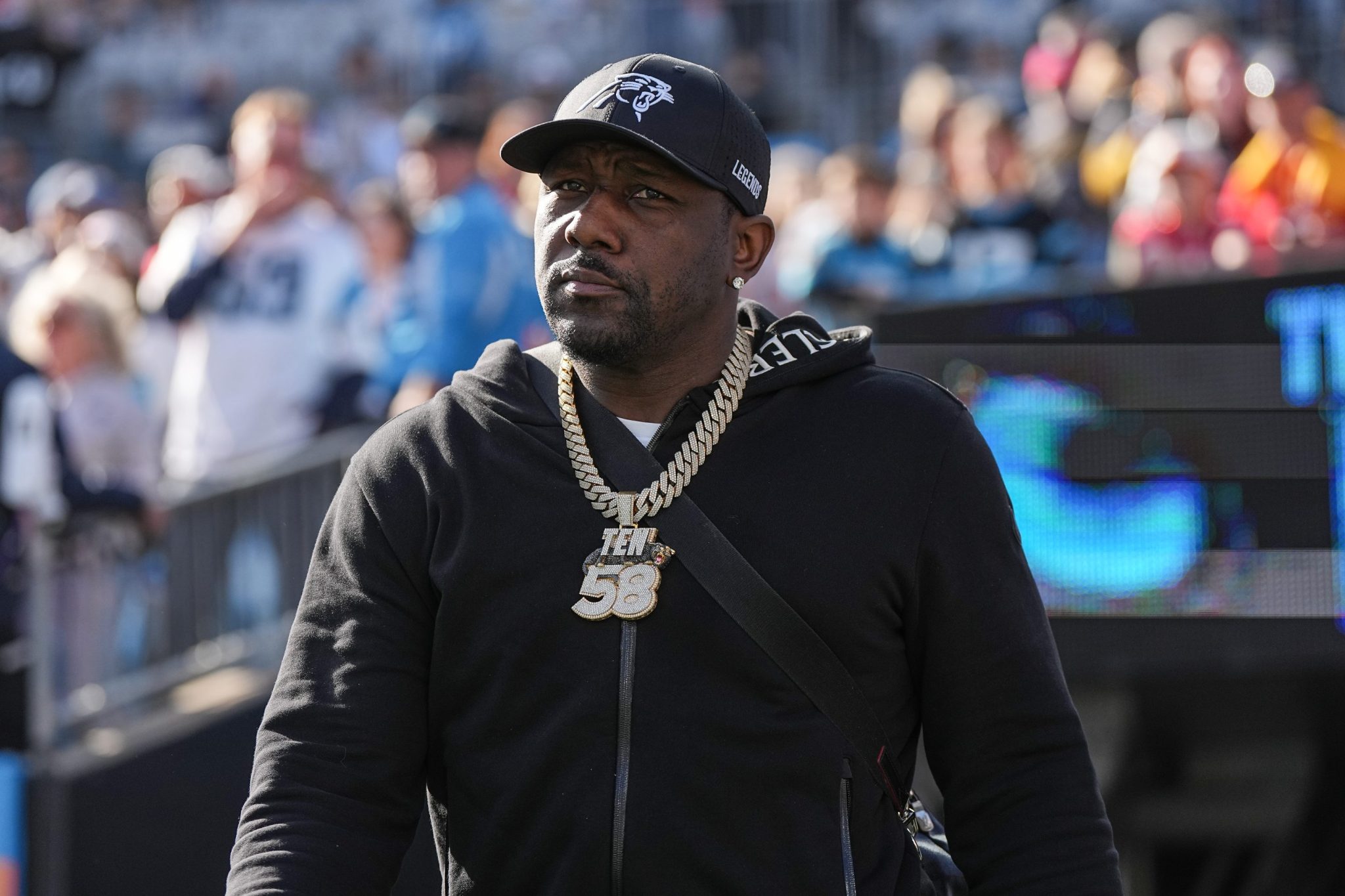
The DEA described how two former athletes received illicit prescriptions from Rubinger, including former All-Pro Carolina Panthers linebacker Thomas Davis, whose wife alerted the agency to the nurse practitioner’s activities, according to the court records and an interview with the player’s now ex-spouse.
Rubinger started prescribing Davis opioids as he was bouncing between teams before he retired after the 2020 season, according to his wife. In all, authorities alleged, he received more than 13,000 oxycodone and Percocet pills between November 2019 and March 2024.
Davis did not respond to requests for comment and no one answered his door in North Carolina when visited by an AP reporter.
The DEA identified another former reserve NBA guard who, along with his wife, paid Rubinger more than $50,000 for illicit prescriptions well after he left the league. He could not be reached for comment.
Rubinger’s case did not result in criminal charges
A spokesman for Rubinger, Erick Mullen, did not answer questions about the nurse practitioner’s treatment of Davis or any other athlete, citing medical privacy laws.
“Joan’s case was not a criminal matter but a civil action,” he wrote in an email. “No raids with blue windbreakers carrying agency initials, and no loss of liberty at stake.”
He said “no administrative or disciplinary actions” had been taken by nursing boards in California and New York, where she is licensed to practice.
Mullen also did not address AP’s questions about Rubinger’s alleged ties to the Ohio-based Loyal to Brothers street gang but suggested they represented “actual harm” to his client. “You’ll have to imagine what kind of people threatened, intimidated, bullied and cajoled a paraplegic nurse practitioner and single mother into this kind of situation,” he wrote.
Federal prosecutors declined to comment on why they did not pursue criminal charges even as they accused Rubinger in court filings of violating federal drug statutes and regulations 900 times.
James Rafalski, a retired DEA investigator, said he worked many cases that ended in criminal charges and involved far larger volumes of pills. But Rubinger’s conduct stood out as especially flagrant, he said, adding he was surprised it did not result in a criminal prosecution.
“Most doctors who abuse their DEA registration just write scripts without a thorough examination of the patient,” said Rafalski, who reviewed court records in the case. “She knowingly took steps to evade detection by the DEA and instructed her clients to do the same.”
Prosecutors weigh a variety of factors in deciding whether to bring criminal charges, from the strength of the evidence to how a jury is likely to perceive a defendant.
Eric Grant, the U.S. attorney in Sacramento, said in a statement to AP that “the significant financial penalty” and ban on Rubinger prescribing controlled substances “grants the public meaningful protections against the unlawful dispensing of dangerous drugs.”
A nurse practitioner to the stars
Like many of her clients, Rubinger, 49, was once an elite athlete. As a child, she competed internationally in gymnastics. Years later she rowed and pole vaulted at Syracuse University.
After graduating, she coached women’s rowing at Indiana University, worked alongside elite NBA trainers and even assisted China’s Olympic volleyball team.
“My sculpted physique and bronzed, sun kissed skin were fruits of very hard labor,” she boasted in a personal blog. “Earned. Day after pavement-pounding day.”
She started All Pro Sports Medicine around 2010, describing her company as a niche service that offered athletes discrete medical attention at all hours of the day. In 2014, she was licensed as a nurse practitioner in California, which would’ve made it possible for her to prescribe medication.
Justice Department lawyers described her practice as “highly unorthodox” because it often operated out of hotel rooms, devoid of any medical records or a physician’s supervision.
Rubinger filled her website and social media accounts with testimonials from athletes praising her sports medicine practice. Among those she featured in her feeds were the NFL’s Drew Brees and Saquon Barkley, as well as the NBA’s Wade and Bryant. Major League Baseball’s Manny Machado also offered praise. There’s no suggestion in court records that Brees, Barkley, Bryant, Machado or Wade committed any wrongdoing or were even aware of Rubinger’s alleged prescription practices. Their statements of support all predated the Justice Department complaint. Representatives for the athletes did not respond to requests for comment. Bryant died in a helicopter crash in 2020.
Tatis, a teammate of Machado’s on the San Diego Padres, confirmed he had also been a client of Rubinger but was not aware she had been accused of issuing illicit prescriptions.
“We were always clear on what I wanted,” he told AP. “It was hydration and stuff to keep me on the field, and we were really professional and it was really clear on my side.”
The buzz surrounding Rubinger’s practice stemmed, in part, from “The Goo,” a pain-relieving gel she created. Rubinger marketed “The Goo” as a “wonder cream” and “Pro Athletes’ Best Kept Secret.” It contains the same active ingredients found in over-the-counter pain-relief gels like Bengay.
“I could literally submerge my whole body in a bathtub of Goo, man,” Davis, the linebacker, said in a 2022 video promoting the pain relief treatment.
Recovery from bike accident inspires top athletes
Rubinger’s life took a near tragic turn in 2015 when she plummeted 20 feet over the edge of a cliff while riding a mountain bike. The crash broke more than a dozen ribs, punctured her lungs and left her with spinal cord injuries that left her in a wheelchair.
“I don’t know who I am anymore,” she wrote in the blog chronicling her recovery. “I’ve lost my identity. It terrifies me.”
She initially struggled with simple tasks like brushing her teeth. Nevertheless, she returned to work in just three months. Following Rubinger’s comeback, several NBA players, including Wade, wore orange wristbands in her honor on the court.
“You would look at Joan sitting quietly in her wheelchair and never know that she is the secret weapon behind the best athletes in the world,” Atlanta Hawks guard Buddy Hield wrote in one of several testimonials featured on her company’s website.
Hield did not respond to requests for comment made through the Hawks.
Nurse practitioner allegedly took steps to avert DEA attention
The DEA alleged that Rubinger went to great lengths to conceal her illicit operation.
New clients had to follow specific steps Rubinger outlined in a document she called “THE RULES,” court records show, threatening to cut off anyone who slipped up.
“I put these rules in place for a reason: to minimize the attention we attract from the DEA,” she told one prospective client, according to the seizure affidavit, which allowed agents to confiscate nearly $170,000 in what it deemed “crime proceeds” from her bank account.
Investigators say Rubinger collected hundreds of thousands of dollars through a digital money transfer app to provide clients with prescriptions for painkillers. She made them pay up front, the DEA said, distributing a price list for painkillers.
Getting a prescription, she told clients in “The Rules,” was “like at McDonald’s, you gotta pay for your burger before they hand it to you.”
In early 2024, the DEA said it inspected a Stockton, California, doctor’s office where Rubinger had registered her practice. The office belonged to an orthopedic surgeon Rubinger had shadowed years earlier. The surgeon told authorities he had no role supervising her work nor any knowledge of her prolific prescribing activity, according to the DEA order revoking her prescribing registration.
Many states, including California, require nurse practitioners in most circumstances to work under a physician’s supervision when prescribing opioids.
In social media posts, Rubinger and her athlete clients regularly refer to the nurse practitioner as “Dr. Joan.” Nurse practitioners, however, are not considered doctors.
Her website claims she holds a Ph.D., and her LinkedIn profile lists an unspecified “doctoral degree” from the Ohio State University.
A spokesperson for the university said it has no record of Rubinger attending or working at Ohio State. Mullen, her spokesperson, did not answer questions about her graduate studies.
Rubinger holds master’s degrees in nursing and kinesiology from Indiana University and The George Washington University.
Wife of NFL linebacker tips off DEA
The DEA began investigating Rubinger in 2022 after being tipped off by the wife of Davis, the former NFL linebacker.
Kelly Davis told authorities and the AP that she visited an emergency room in 2022 near her home in Charlotte, North Carolina, complaining of chest pains. As she was being evaluated, a doctor informed her she had been flagged for receiving excessive pain medication prescriptions.
Unbeknownst to her, Rubinger had written 23 oxycodone prescriptions for her husband over a two-year period listing her as the patient, according to the DEA and Kelly Davis.
In court documents, the DEA said Rubinger took such steps with her clients “to obscure her excessive prescribing and avoid law enforcement detection.”
“These individuals are not the intended recipients of the prescriptions, often do not even know they are being prescribed controlled substances,” the DEA wrote, “and have not been examined by Rubinger, much less have an established doctor-patient relationship with her.”
Kelly Davis said she was stunned by the revelation and immediately confronted Rubinger through Instagram.
“This is insane,” the football player’s wife wrote to Rubinger, according to the DEA’s revocation order. “You clearly know he has a problem. Why would you do this?”
Kelly Davis said the nurse practitioner was well liked by players and recalled running into another professional athlete the one time she met Rubinger while accompanying her husband to a 2020 appointment at a Marriott in Charlotte.
NFL has long struggled with painkillers
The NFL has well-documented problems with painkillers. A 2011 study found that 52% of the league’s retired players used opioids during their career. More recently came a 2020 investigation of the head trainer for the Washington Commanders for illegally distributing oxycodone to players. The trainer accepted a $10,000 fine under a deal with the Justice Department to avoid prosecution if he stayed out of trouble. An attorney for the trainer declined to comment.
The NFL has put in place more diligent accounting of drug prescriptions. Players are allowed to go outside their teams for medical care, though since 2019, they’ve been required to report any prescriptions they receive from outside their team.
Shortly after reporting Rubinger to the DEA, Kelly Davis shared her suspicions with the NFL Players Association and the California Board of Registered Nursing. The Players Association declined to comment; the NFL said it had no awareness of Rubinger; and the California nursing board said it does not discuss any disciplinary actions until they are finalized.
Kelly Davis said her husband’s use of opioids contributed to the demise of her marriage. The couple divorced last year.
In a May interview on The Pivot Podcast, Davis blamed his opioid abuse for wrecking his home life.
“There’s a lot of shame and guilt,” he said, holding back tears. “I’ve always been a person and a player that said that I would never allow anything to control me.”
___
Goodman reported from Miami, and Pells from Denver. Associated Press journalists Brett Martel in New Orleans, Rob Maaddi in Tampa and Michael Reo in Washington contributed reporting. Retired AP reporter Bernie Wilson contributed reporting from San Diego.
#McDonalds #Sports #nurse #practitioner #sold #opioids #athletes #gotta #pay #burger #DEA #investigation #finds