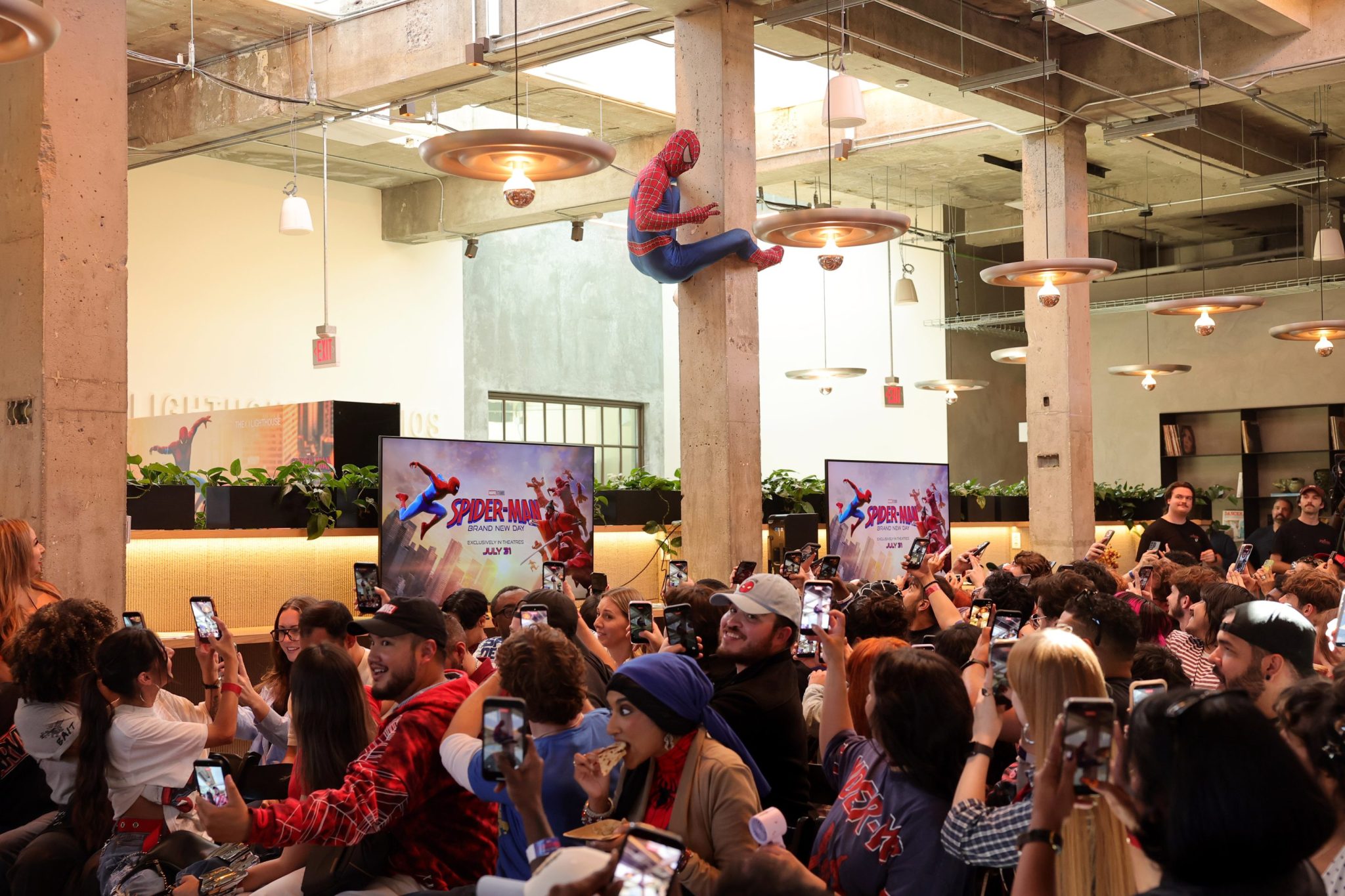
Spider-Man swung, Odysseus sailed, and Hollywood rode them to its biggest summer box office ever. There was just one thing missing: nearly 249 million ticket sales.
Theaters across the U.S. and Canada generated $4.765 billion between May 1 and Labor Day, surpassing the all-time record set in 2013 by just $9.3 million, according to data from box-office analytics firm Rentrak, sent to Fortune. But rising ticket prices helped create that apparent comeback. Adjusted for inflation, this summer’s box office remained 17% below 2019, according to the New York Times, while cinemas sold nearly 249 million fewer tickets through mid-August than during the same period that year.
Not everyone thinks 2019 is the right yardstick. Paul Dergarabedian, the widely cited head of marketplace trends at Rentrak, told Fortune that he thinks the more instructive baseline is 2020, when theatrical attendance collapsed to nearly zero. A record-breaking summer in a “different era,” seven years on from the pre-pandemic times, in the midst of a streaming-saturated landscape, “speaks volumes to how important the movie theater experience is, culturally and financially.”
That gap points to Hollywood’s emerging post-pandemic business model. Higher prices and premium screenings are helping the industry make more money from fewer customers, masking how far attendance remains from a full recovery—and raising questions about whether a business built on $20 tickets and a handful of event films can last.
Dergarabedian agreed that the business model is evolving, saying that he sees a lot of evidence that filmmakers and studios supporting are “thinking outside the box.” Hopefully, he added, “they’re hiring younger people with their finger on the pulse and ear to the ground about what younger audiences want. He compared the evolution of Hollywood to the rise of vegetarianism, of all things. “There may be fewer hamburgers sold [nowadays],” he said, because of the rise of lean and meat-free diets, “but 50 years ago, there weren’t any vegetarian options.” The same thing is happening with theaters and streaming now.
The analyst agreed that the restaurant industry has had to reinvent itself in a similar way since the pandemic and pointed out “these things don’t happen in a vacuum,” noting the drinking-averse Gen Z is increasingly having a wholesome night at the movies instead of a rowdy night at a bar. And their taste is different in a refreshing way.
Dergarabedian cited the unlikely twin successes of the highbrow Odyssey and the blockbuster Spider-Man, each grossing over $1 billion worldwide. Together, they accounted for nearly one-third of the summer box office. Similarly, Obsession stood out on Memorial Day as The Mandalorian and Grogu disappointed. “The audience is telling you they want a mix of that cinematic fast food and cinematic fine dining,” he said.
Hollywood traditionally measures box-office success using raw revenue without adjusting older totals for inflation. By that accounting, this summer’s haul was 9% higher than the $4.35 billion collected during the summer of 2019. Adjusting for inflation raises the 2019 total to approximately $5.7 billion, and admissions reveal that gap even more clearly. North American cinemas sold 547.1 million tickets through mid-August, compared with 795.9 million during the same period in 2019, according to S&P Global Market Intelligence data reported by the Associated Press.
Inflation is not the only asterisk attached to Hollywood’s record. The 2026 summer movie season lasted 130 days—one week longer than the comparable period in 2013—Texas Capital noted in its Sept. 8 research note.
Still, the recovery isn’t pure movie magic. Summer revenue rose 26.1% from last year, while year-to-date box-office revenue reached $7.384 billion, up 20.8%. Texas Capital sees a path for Hollywood to reach $10 billion in 2026 for the first time since before the pandemic.
The premium plot twist
Cinemark’s financial results show how theatres are making the math work. Premium large-format screenings generated nearly 15% of its worldwide box office during the second quarter despite representing just 6% of its auditoriums, according to the company’s executive commentary. Its D-BOX motion-seat sales also climbed more than 50% from a year earlier to an all-time quarterly record.
Cinemark’s average U.S. ticket price increased 4.2% to $10.83 during the quarter. The company attributed the increase to “strategic pricing actions and higher premium format mix” in its quarterly filing.
Moviegoers aren’t just shelling out more to get through the door. They’re also leaving more money at the concession stand—apparently, not everyone is sneaking in Sour Patch Kids. Cinemark’s concession revenue per patron rose 4.3% to $8.70, driven by pricing actions and its mix of products. Together, moviegoers spent an average of $19.53 per visit on tickets and concessions.
AMC has seen a similar payoff. The theater giant finished 2025 with all-time per-patron records for admissions, food and beverages, and total revenue, according to a company filing. Its attendance climbed 17.9% during the second quarter of 2026, while revenue reached a company-record $1.6 billion.
Eric Wold, an equity analyst at Texas Capital Securities who covers Cinemark, told Fortune that theaters continue to face pressure from fewer theatrical releases and the growing availability of movies through streaming. But the customers who still visit are increasingly choosing premium screenings and spending more at concession stands.
Combined with tighter control of operating expenses, those trends give theater companies the ability to generate “greater profitability from a lower number of total movie tickets sold,” Wold told Fortune.
His research suggests the model is already translating into stronger earnings. Wold projects the third-quarter domestic box office could reach $2.85 billion, slightly exceeding the $2.813 billion generated during the same quarter in 2019—even as attendance remains well below its pre-pandemic level. Under that scenario, Wold estimates AMC’s adjusted earnings before interest, taxes, depreciation and amortization could reach $256 million, compared with his current $174 million estimate. Cinemark could generate $259 million, compared with his $194 million estimate.
Higher prices do not necessarily mean theaters must abandon lower-income customers, Wold said. Premium screenings remain a choice, while theaters offer cheaper alternatives through weekday discounts and matinees.
As Fortune previously reported, audiences are increasingly treating premium screenings as experiences they cannot replicate at home. “The Odyssey” made that literal, selling out even 3 a.m. screenings in true IMAX 70 mm and delivering the biggest opening weekend in IMAX history.
Hollywood’s next test is fittingly called “Doomsday.”
Avengers: Doomsday and Dune: Part Three will both arrive on Dec. 18, once again asking audiences to treat moviegoing as a premium-priced event. “Dune,” which was shot with IMAX film cameras, already has select 70 mm screenings on sale. Meanwhile, Disney is positioning “Doomsday” as a showcase for Infinity Vision, its new certification for premium theaters with large screens, laser projection and immersive sound.
For his part, Dergarabedian predicted that Dec. 18 will be the biggest weekend in box-office history, and he compared 2026 for Gen Z to his own experience in 1975, seeing Jaws at age 14, and then seeing Star Wars at 16 in 1977, setting him up for a lifetime of moviegoing. “There’s a future for this industry that I think is assured and bolstered by the fact that younger audiences are coming out — that’s the future of the business, generational attendance.” He also said that he’s not always the cinema optimist, warning that 2027 will find this year a “very tough opening act to follow.”
#Hollywoods #business #model #view #Gen #shows #moviegoing #taste #combines #fast #food #fine #dining