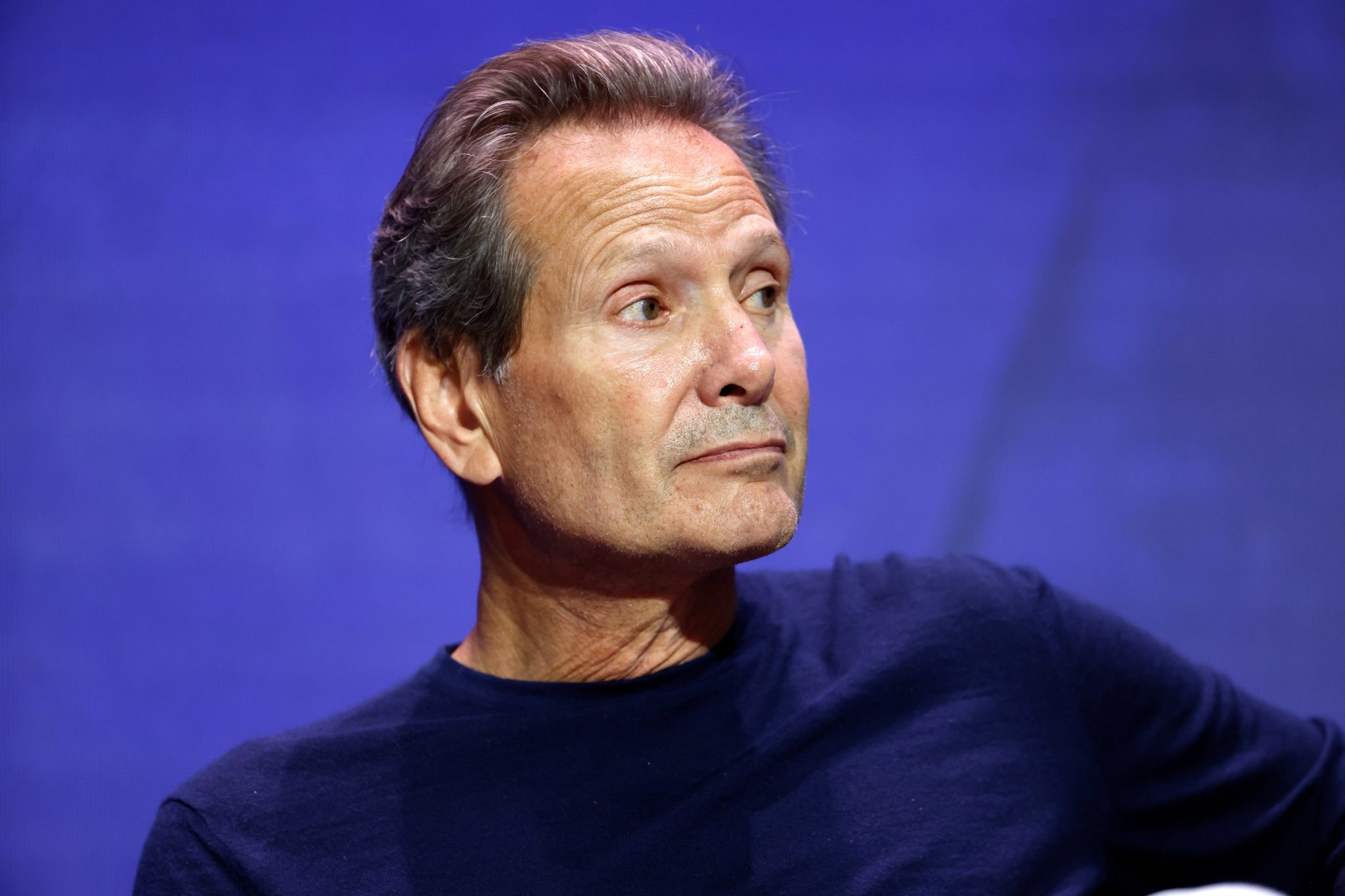
Verizon CEO Dan Schulman offered a strikingly aggressive forecast for artificial intelligence’s development at the Ford Pro Accelerate event in Detroit, saying that an earthquake is headed our way.
“The models that we see today are the worst models we’ll ever use in our lives,” Schulman said in conversation with Fortune‘s Diane Brady. “Every two months, there’s a step function change in the power of the models. I think we get to some form of AGI in the next six to 18 months. I think it’s right on us.”
Two years after that, he added, we will arrive at “the era of quantum,” which he described as “everything today times 1,000.” By 2030 or 2035, we will see “a pretty good form of humanoid robotics.” Summing it up, he added, “we’ve got a decade of intense change ahead of us.”
AGI, or artificial general intelligence, is a term generally used for systems that can reason and perform broadly across domains rather than excel at discrete tasks. Schulman argued that AI’s economic and social effects will arrive at a pace that outstrips the usual mechanisms for absorbing technological change, such as training systems, labor markets, corporate restructuring and public policy. “It is about machines that will in many ways be able to do things better than a lot of human tasks are done today,” he said.
“I think you’ll see the collapse of the 21st century in the next five to 10 years,” Schulman said. When Brady asked what he meant by collapse, he explained “progress we would have made over 100 years will happen over the next five to 10 years.”
“I don’t think we can really imagine how powerful the technology and how fundamental it will be.”
Verizon’s disruption
Schulman said the change would reach his company itself. Verizon, he said, has more than 250,000 employees and contractors and will need to move from a workforce organized around “very defined roles and functions” to a “much more fluid organization.”
“The technology is coming,” he said. “There will be safeguards around it. There need to be additional safeguards, but it will continue on.” He urged corporate leaders and government to prepare for difficult scenarios rather than assume the labor market will naturally adjust.
“At Verizon, last week we announced a $70 million initiative to do training for American workers, not just Verizon workers, but American workers in the community across the country,” Schulman said.
The initiative includes free AI training and work with local organizations on career development, he said, before adding a prescription for all leaders and policymakers. “Our responsibility is to think about what might go wrong, what might we need to address, what might the disruption look like, and how do we put guardrails, training, programs in place to minimize that risk,” Schulman said.
“Everybody’s job is going to shift,” Schulman said. “I don’t think everybody will land just magically in a better place per se.”
Other executives on Schulman’s panel described different constraints on the AI future. There will always be a need for someone to lay fiber, install power equipment, maintain transmission lines, retrofit buildings and wire the data centers that AI requires.
For PG&E CEO Patti Poppe, the central challenge is that an increasingly digitized grid will require workers to combine physical skills with technological fluency. Poppe described seeing one of PG&E’s workers being lowered by rope from a helicopter onto a transmission tower in mountainous California. The company’s future grid, she said, will use sensors, remote-edge computing and predictive capabilities to identify risks before they create outages or wildfires. But that system will still require skilled people in the field.
“The same guys who hang on the end of the rope are going to have to get smarter about those kinds of technologies,” Poppe said. “I’m still going to need those people. Somebody’s still going to have to connect that wire to the pole.”
From replacement to augmentation
Dave Regnery, CEO of Trane Technologies, urged students and workers to embrace AI and compared current anxieties to fears surrounding the arrival of personal computers, while adding a dash of hindsight.
“Go take your favorite AI tool” and look up articles from 40 years ago about personal computers, Regnery said. “They’re identical.”
His company sees AI as a way to make buildings run more efficiently, rather than simply to reduce headcount. Trane is using data and AI to manage heating, ventilation and air-conditioning systems according to how buildings are actually used, he said—not merely according to their original design specifications.
“Most people don’t realize that 30% of all the energy is for buildings,” Regnery said. “And you know what? Thirty percent of that is wasted.”
He said the company can make buildings operate roughly 15% more efficiently than their design baseline, improving economics for customers while creating demand for technicians capable of installing, servicing and operating increasingly sophisticated systems, offering a counterweight to the idea that the technology’s principal effect will be displacement.
“The fastest speed-to-power solution is use the essential equipment that you have,” Regnery said.
The construction-site version of AI
Chris Nelson, CEO of Stanley Black & Decker, described a similar transition on job sites. His company has developed AI-enabled autonomous drilling robots that can use digital construction plans to drill holes for racks in data centers and other projects.
The technology is designed to take over repetitive physical tasks—not replace the electricians and skilled tradespeople needed to complete the higher-value work.
“What do the electricians and other skilled tradespeople not like to do all day?” Nelson said. “Sit and core drill.”
The machines can connect to digital drawings, map routes and drill on their own, he said. That frees skilled workers to pull wire, terminate connections and solve the problems that still require judgment and technical training.
“The holes will still need to be drilled from now until maybe the end of time,” Nelson said. “But the way we do it and what it enables people to think about for the future is going to be materially different.”
Nelson called AI a “companion on the construction site,” a framing that is more incremental than Schulman’s vision of near-term AGI but still acknowledges that technology is changing the work itself. The question, he suggested, is whether companies can turn that change into a career draw—giving workers more engaging tasks, more decision-making authority and a clearer path to starting their own businesses or moving into management.
A labor shortage, not a labor surplus
For Dycom CEO Dan Peyovich, whose company builds telecommunications infrastructure, the immediate business problem is not a surplus of workers displaced by AI. It is finding enough people to build the physical networks that the technology boom requires.
“There’s so much infrastructure that has to get put in place for all of this to happen,” Peyovich said.
His company employs roughly 21,000 people nationwide, he said, connecting homes and businesses through fiber and telecommunications infrastructure. Its response to a tightening labor market has been to improve field-worker benefits, including paid time off, holidays, health coverage and training that goes beyond technical credentials.
Dycom has also built a training facility near Atlanta that includes instruction in technical skills, management, leadership, the use of technology in day-to-day work and potentially personal finance, Peyovich said.
The strategy reflects a different labor-market assumption from the one embedded in much AI commentary. Instead of treating workers as interchangeable units who need only learn a new software tool, Peyovich described a system in which companies must offer a credible long-term career proposition—training, benefits, advancement and financial stability—to recruit people into difficult field jobs.
“We want to try and create a path for people,” he said. “While they’re getting a paycheck, they can learn and find their way.”
The tone was collegial, and Schulman didn’t take issue with any of his co-panelists’ predictions about the future of work. His main point was that business leaders should not bet on a painless adjustment.
“We need to be prepared in case a different scenario emerges,” he said, “so that we can make sure that we have skilled workers, whether they be craftsmen or professionals.”
His final prescription was scenario planning: leaders should ask what happens if AI’s gains arrive faster than jobs, training and institutions can adjust.
“Our responsibility is to think about what might go wrong, what might we need to address, what might the disruption look like, and how do we put guardrails, training, programs in place to minimize that risk,” Schulman said.
#Verizon #CEO #Dan #Schulman #sees #AGI #monthsand #century #progress #decade