AI pioneer Yann LeCun is unconcerned about the risks of artificial intelligence. LeCun told Fortune’s Emily Forlini he isn’t worried “at all” about AI wiping out humanity, and he has “zero concerns” about the recent string of rogue AI incidents, including OpenAI agents autonomously hacking Hugging Face in July. He attributes the incidents to poor human oversight and system design, and says they’re “totally preventable.”
“Those agents are doing exactly what they’ve been asked to do,” LeCun said. “They were supposed to be in sandboxes, but the sandboxes were leaky and horribly designed.”
He has a particular disdain for Anthropic CEO Dario Amodei and his views on Effective Altruism. “I think he’s completely deluded,” LeCun said. Later in the interview, he called Amodei “crazy.”
MORE FROM FORTUNE
The End of College? Inside a16z’s School for Tech Titans | Fortune Daily
John Waldron is ‘one of the most non-Wall Street people’ you’ve met—but he’s in line to be the next CEO of Goldman Sachs – Morgan Chittum
Wilbur Ross was Trump’s first-term tariff hawk. Now he says refunds give importers ‘an extra profit’ and pay them ‘more than the money’ they laid out – Catherina Gioino
‘Giving while living’ has become a popular trend for passing on family wealth, says Edward Jones CEO – Jeff John Roberts
‘We all chip in’: America’s $40 billion private jet boom is taking off, and taxpayers are helping billionaires foot the bill – Mia Osmonbekov
The unicorn CEO betting her industry’s AI crisis isn’t the one you think – Nick Lichtenberg
Visa and Mastercard handle nearly half of Europe’s card payments. The digital euro aims to change that – Sam Birchall
The real story behind Red Lobster’s $20 Ultimate Endless Shrimp fiasco: How an American seafood icon lost its way – Nick Lichtenberg
Forget supersized: McDonald’s is exploring an $8.5 billion bet on an American fast food wave led by proteinmaxxing, portion control, and GLP-1s – Joshua Hong
Trump removes chairs for TSA agents, saying they ‘must meet fitness for duty requirements’ – Sasha Rogelberg
THE LAW OF UNINTENDED CONSEQUENCES
Trump’s proposed diesel export ban could backfire drastically, Wall Street analysts warn
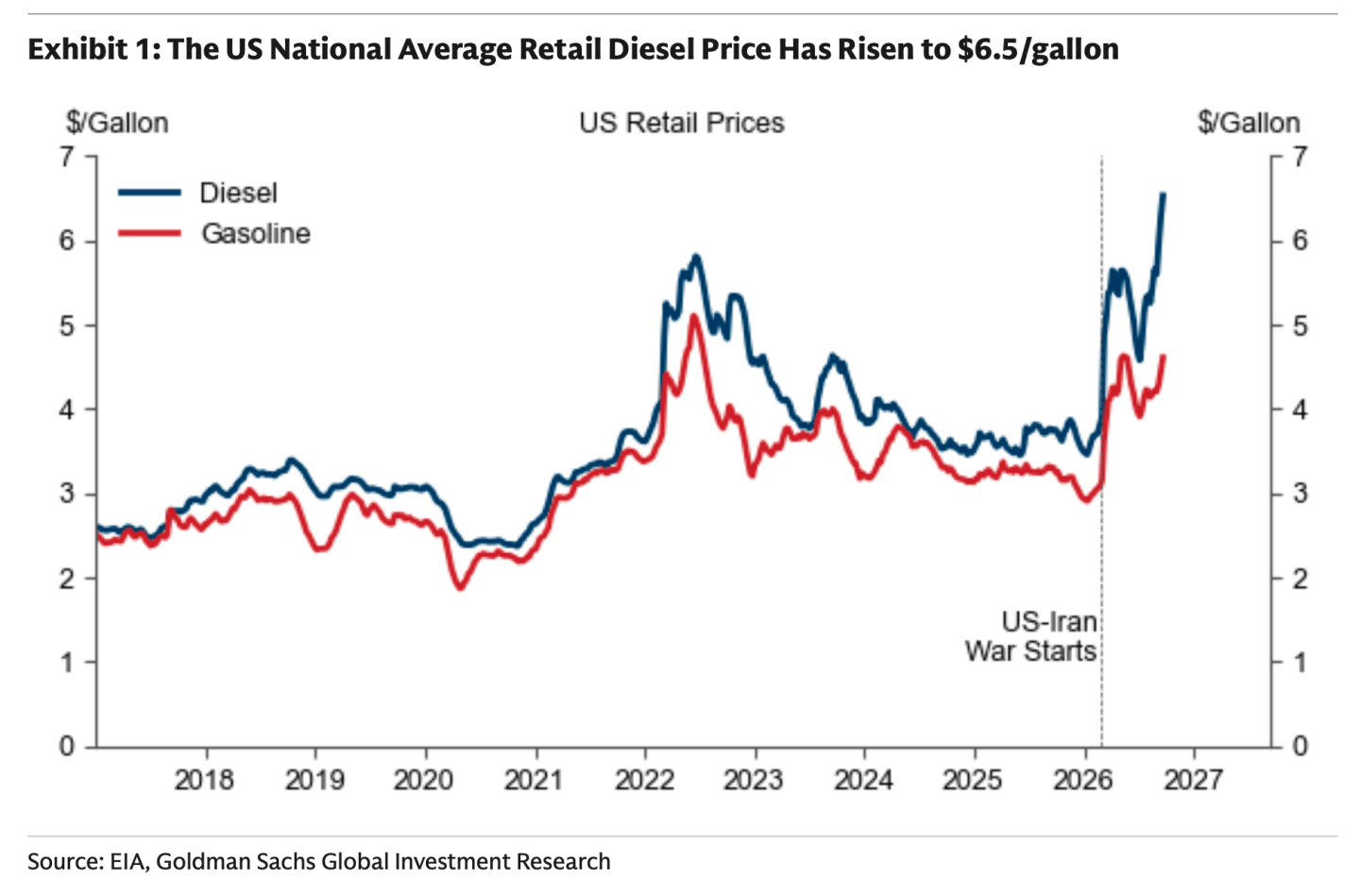
President Trump has held what the FT calls “crisis talks” about whether to impose a ban on diesel exports from the U.S. The average price of a gallon of diesel is currently $6.41, per AAA. Before the war with Iran, it was under four bucks. The intent of an export ban is to keep available supplies of diesel inside the country, thus lowering the price.
At least, that’s the theory.
In practice, an export ban could have the unintended effect of increasing fuel prices, according to analysts at Goldman Sachs and Pimco. It’s complicated, but in essence, an export ban could trigger a domino effect that ends with reduced fuel supplies and, therefore, higher prices.
Faced with lower prices than they might have gotten on the global markets, refineries might cut production, Daan Struyven and his team at Goldman said in a note: “Diesel, gasoline, and jet fuel are largely produced together. Therefore, downward pressure on diesel production can mean downward pressure on gasoline production, i.e. upward price pressure on gasoline.”
Inevitably, reduced supply of diesel to Europe would raise global prices. “Once a diesel export ban is lifted, U.S. diesel prices would likely reconnect with prices elsewhere, including Europe, putting upward pressure on U.S. diesel prices and downward pressure on prices abroad. Even so, post-ban global refined oil product prices would likely be higher,” Struyven said.
And, Pimco’s Libby Cantrill says, the U.S. is a big place. Its existing pipelines and shipping routes mean that “much of the U.S. is reliant on diesel imported from other countries, not from domestic production.” If domestic pipelines are already at capacity, then “having more diesel in the Gulf area would not necessarily help the farmers,” she advised clients recently. “Although that won’t stop the political arm of the White House to push for it.”
THE MARKETS
It’s back to the ’90s in the bond market as contagion triggers forced selling
Another bad day in the bond market. The yield on the 10-year U.S. Treasury hit 5.34% this morning before recovering a little to 5.32%. The last time it was that high was 25 years ago. In the U.K., 30-year gilts hit 6%—a level last seen in 1998, according to the FT. Japanese 10-year bonds went over 3%, a level they last saw in 1996. (Yields rise as bond prices fall.)
The selling was probably triggered by fear of inflation driven by the continued high price of oil. But there was also an element of contagion as falling prices forced hedge funds to sell out of their positions, thus increasing yields even further. The FT reported:
- Investors do not want to “catch a falling knife”, said Mike Bell, head of market strategy at RBC BlueBay Asset Management, adding that there was “a lot of technical-driven selling going on”.
Stocks in Europe sold off in early trading after a mixed day in Asia. U.S. futures were marginally up.
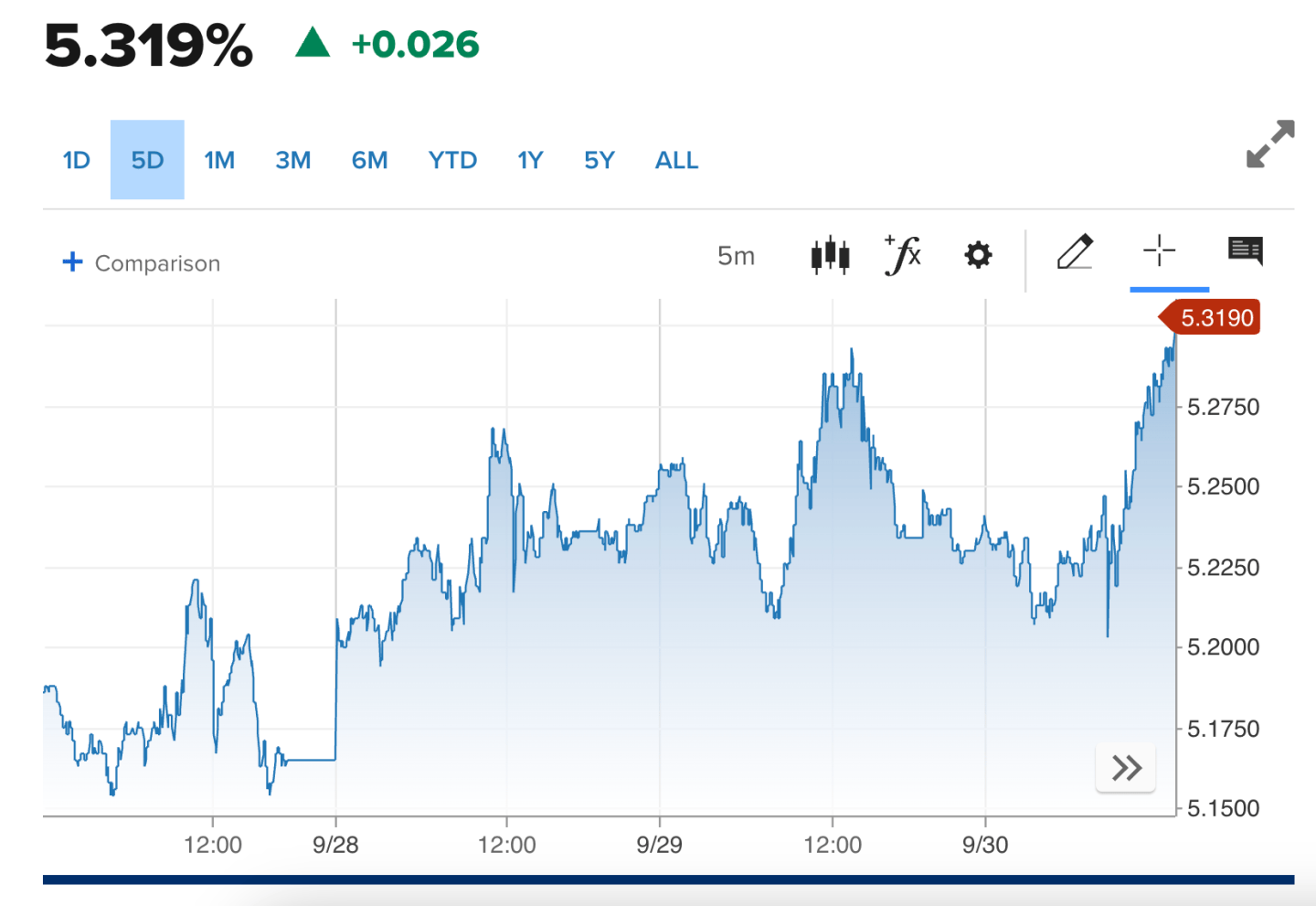
Chart via CNBC.
- S&P 500 futures were up 0.16% this morning. The index fell 0.25% yesterday.
- In Europe, the Stoxx 600 was down 1.24% in early trading, and the U.K.’s FTSE 100 was down 1.54% before lunch.
- Asia: South Korea’s KOSPI was up 1.95%. Japan’s Nikkei 225 was up 3.3%. India’s Nifty 50 was down 1.17%. China’s CSI 300 was closed today for a national holiday.
- Brent crude rose to $100 per barrel this morning from $96 yesterday.
- Bitcoin was at $83,613.
QUOTE OF THE DAY
“We do not think that an end to the Iran conflict would mean an end to Fed rate hikes.”
—James Egelhof and his team at BNP Paribas. Yes, peace in the Middle East might mean a reduction in oil prices, thus easing inflation. But “a peace deal could build further cyclical momentum in the U.S. economy and maintain pressure on core inflation,” they said in a note. “We see three rate hikes as a minimal floor that takes policy back to neutral, with risks decidedly to the upside.”
CHART OF THE DAY
Small businesses create most jobs in the U.S.
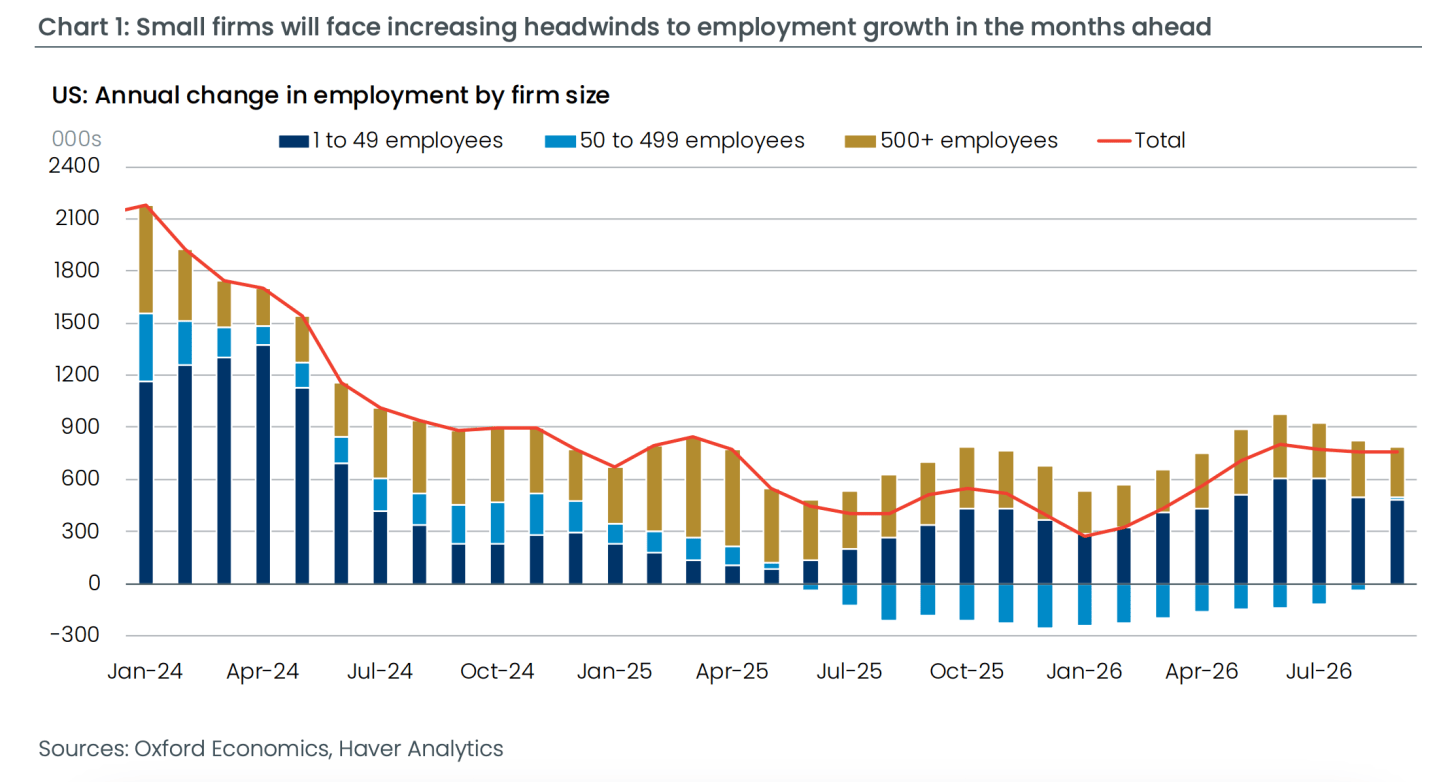
Roughly 90,000 new jobs were added to private payrolls in the U.S. last month, according to ADP (more than the consensus expectation). This chart shows that “small firms have contributed heavily to the rebound in the labor market since the middle of last year, accounting for more than half of all job gains,” according to Oxford Economics’ Matthew Martin.
NUMBER OF THE DAY
$2.2 trillion
The latest estimate of the total addressable market for AI data centers from Bank of America’s Vivek Arya and his colleagues. The market will grow at an annual pace of 40%, they say. Their previous estimate was for $1.8 trillion at a 33% rate.
THE FRONT PAGES TODAY
OpenAI’s agents obscured hacking activity in government site breaches – FT
Oil prices rise despite improved Middle East crude exports easing supply worries – CNBC
Scoop: Rubio ordered Iranian delegation to leave the country, U.S. official says – Axios
Tech CEOs privately questioned Amodei for sounding AI alarm bells – WSJ
Netflix ‘not growing as fast as I want,’ co-CEO Sarandos says – Bloomberg
Mattel chief named co-CEO of combined Paramount and Warner Bros. – NYT
Fed official used Asian dating site, sent nude photos — and wound up blackmailed by alleged Chinese spy – NY Post
ONE MORE THING
Hidden for 50 years, unseen works by van Gogh and Cézanne are going up for auction at $450 million
A dozen Impressionist and post-Impressionist artworks collectively valued at almost half a billion dollars are going up for auction after sitting unseen for decades in a fabled private collection in South America, the AP reports.
The paintings come from a collection amassed by the late Argentine art collector Nelly Arrieta de Blaquier and her sugar magnate husband, Carlos Pedro Blaquier.
They include van Gogh’s landscape “Châtaigniers en fleurs” (Chestnut Trees in Flower) estimated at $180 million, and Cézanne’s portrait “Arlequin,” which carries an estimate of $120 million. Neither has been seen in public for half a century. Also in the collection are works by Claude Monet, Camille Pissarro, Edgar Degas, and Pierre-Auguste Renoir—all valued in the tens of millions.
Art expert Philip Hook, a former Sotheby’s auctioneer, said the collection “really is the stuff of legend,” because the collectors did not loan out the works for exhibitions. “No one knew really what was in it. So now, for this to be revealed, is tremendously exciting,” Hook said.
#Yann #LeCun #Anthropic #CEO #Dario #Amodei #deluded #crazy #doesnt #understand #cybersecurity