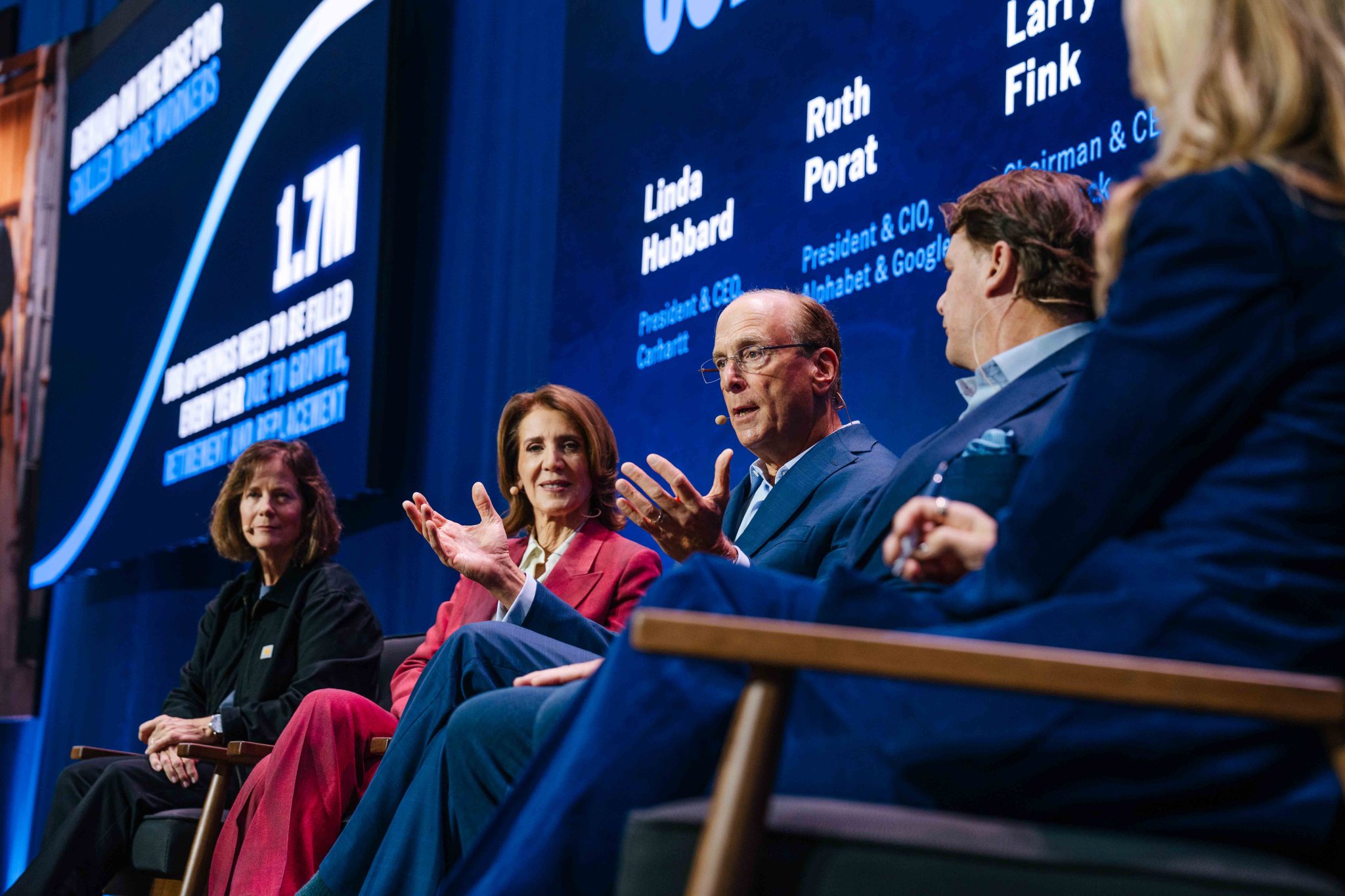
Larry Fink remembers a time when a career was something a person kept for life. That time is gone, he said.
“When you think about what the bedrock of America was, it was about having a career,” the BlackRock chairman and CEO said Wednesday at Ford’s Accelerate forum at Michigan Central. “I think we lost that.” He described how people then began “jumping around to jobs and jobs and jobs,” and it became rare to have a “connection to where you work.”
Fink said the churn weakens the tie between a worker and an employer. “It doesn’t create the stability in life,” he said, arguing that “we all need to focus on how to rebuild that foundation.” That has to be rebuilt “on trust” but also the certainty that if you choose a career, that career can take you throughout a life journey through raising a family, building your children’s careers, ultimately to retirement. “This is more of a fantasy than a reality for too many families,” he said, “and we’ve got to bring those values back.”
His model was his father. “My father essentially had one job in his career, and that was a foundation of America,” Fink said. His father owned a shoe store, where Fink started working at 11. Asked whether that was legal, Fink joked, “I don’t think anyone was paid minimum wage.”
Fink spoke on a panel called “America’s Skilled Trades Resurgence: A Call for Collective Action” with Ford CEO Jim Farley, Carhartt President and CEO Linda Hubbard, and Alphabet and Google President and Chief Investment Officer Ruth Porat. Journalist Poppy Harlow moderated. The panelists drew on “The State of America’s Skilled Trades: A National Report,” released this week by the Alliance for America’s Skilled Trades, which Fortune revealed in July was formed by Ford, BlackRock, Google and Carhartt.
The report projects about 1.7 million skilled-trades openings a year through 2035. Harlow said it found only 55 people being trained for every 100 jobs available. She also said only about half of those who start training programs finish, compared with about 90% in high-quality apprenticeship programs.
The overall numbers only partly back up Fink’s argument about the lost bedrock of careers in the U.S. economy. The median wage and salary worker had been with their current employer 4.1 years in January 2026, according to the Bureau of Labor Statistics. In January 1983, the earliest year in the series, it was 3.5 years, according to earlier BLS data.
Break the data out by sex, and Fink’s argument holds up—but only for men. In 1983, men 55 to 64 had been with their employer a median 15.3 years. By January 2026, that was 9.6 years. Men aged 45 to 54 fell from 12.8 years to 7.7 years. The figures cover wage and salary workers only, so a shop owner like Fink’s father wouldn’t be counted at all. The job-for-life that Fink remembers looked a lot like the one Farley went on to describe about his own grandfather, who worked for Ford.
‘My grandfather was an hourly worker for Ford’
Farley described the trades as a path his own family took. “I think like all of us, we’ll find someone in our family that had a skilled trades job that changed the course of our family,” he said. “For me, my grandfather was an hourly worker for Ford. His skilled trade job at Ford put my mom through college, and here I am.”
“I think these jobs are good jobs,” Farley said. “They changed America, and they can change America again. That’s why it’s personal.”
Farley said the cost of doing nothing is concrete. “Things [will] cost a lot more. We’ll wait a lot longer. Our economy won’t grow the way we need to. Our society won’t progress.”
He said the fix is already known: high-quality apprenticeships with support for the people in them. Asked why so many trainees drop out, he pointed to everything outside the classroom. “If you’re in one of these programs and you can’t afford it because they cost money, some of them, and you don’t have a job or you don’t have a way to get to work because you can’t afford a car or you have kids at home and you can’t afford childcare, it doesn’t matter how good the program is,” Farley said. “You’re not going to make it through.”
The answer, he said, is support services, accredited programs and employers connected to apprenticeships, so trainees have a job while they train. “That’s the secret sauce that the report talks about,” he said. “It happens in America. It’s just way too uncommon.”
Farley said when the executives “went around the table” the night before, every one of them had a personal connection to the trades. “We all know as humans that the skilled trades have been a gift to our families,” he said, “and we have a responsibility to pay it forward.”
Wages and investment returns
Fink tied the career argument to a gap between people who own assets and people who earn wages. “There is a big divide right now that those who have investment assets have done better than wages,” he said. “Over the last 25 years, you invested in the U.S. stock market, you earned a 10% compounded return. We have not seen that type of increase in wages.”
From the end of September 2001 through this week, the S&P 500 returned about 10% a year with dividends reinvested, turning $1 into nearly $11, based on annual total-return figures. The start date matters: Measured from January 2001, before the dot-com bust and the 9/11 sell-off fully played out, the annual return drops to about 9%. Paychecks grew far more slowly. The median full-time worker earned $596 a week in the third quarter of 2001 and $1,251 in the second quarter of 2026, according to BLS data, a gain of about 3% a year. After inflation, that’s a raise of about 12% over 25 years.
Fink framed the fix in BlackRock’s terms. “As the largest investor of retirement savings, our job is to focus on the long term,” he said. The firm is “reorienting ourselves to not just focus on the 30-, 40-year outcome,” he said, but on “investing in the beginnings of a career.”
His answer was well-paid trades careers, which he said can let workers save for retirement and invest in the economy they helped build. That, he said, is how to close the gap: “making sure that we’re building an opportunity to build jobs, high-paying jobs,” that give workers “a great retirement pool of savings” and let them “grow with our economy by investing the excess savings with our economy.”
Fink said he has “never been more optimistic about the United States” in his career, and he expects “an investment boom in America” in bridges, airports, ports and technology. “I’ve never seen more interest from investors domestically, both retail and institutionally, and investors throughout the world who would like to invest in America,” he said.
He also said the shortage of skilled workers is already costing the economy. “We have huge skilled-trade shortages in plumbers and welders and electricians and on and on and on,” Fink said. “And these shortages are now slowing down these projects.”
The report was produced in partnership with Jobs for the Future and the Burning Glass Institute, Fortune reported. BlackRock, Carhartt, Ford and Google founded the Alliance in July — the same four companies represented on the panel.
‘Our greatest export has been our children’
Porat said that on visits to training sites she kept hearing the same message. “This is not a job, this is a career,” she said. “This is a career that’s changing my life and my family’s life.” In the middle of the country, someone told her, “Our greatest export has been our children, because they don’t see hope in my town.” She said she believes this is changing, with good jobs coming into the economy.
She described meeting a welding trainee named Danielle at one site. “My husband passed away recently and I have two children,” Porat recalled her saying. “I was a bartender and I was trying to figure out how to take care of my family, how to give them the healthcare insurance, the consistency.”
Hubbard said the barrier is partly cultural. The report found that 84% of students agree that working in the trades deserves respect, Harlow said. But only 33% said they would feel respected by others if they did it.
“Guidance counselors aren’t talking about this as an option to high school students,” Hubbard said. “And maybe we aren’t talking about it enough as parents and family members as well.”
For this story, Fortune journalists used generative AI as a research tool. An editor verified the accuracy of the information before publishing.
#Larry #Fink #lost #bedrock #America #big #divide #wages #investment #wealth