OpenAI CEO Sam Altman told Politico that people should accept the risks of AI in order to gain its benefits. “We believe that the world should accept some bad things happening for the benefits of this technology and people having the agency,” he told the site. The trade-off will be worth it, he argued: “I wouldn’t take a trade of saying, ‘We’ll make sure there’s no major hacks, there’s no misuse of this technology, there’s zero scams, there’s zero all the other bad things that will happen’ … Because I think people will do tremendously—orders of magnitude more—good stuff than bad stuff.”
That’s a tone shift from Altman. When he talked to Fortune’s Alyson Shontell recently, he was more cautious. A 10% risk of AI killing us all by the end of the decade is unacceptable, Altman said. He insisted that OpenAI has not, and would not, take that risk.
“We are entering a new era,” he said. “We are clearly, today, at a point on the curve with great potential and real risk.”
“We have not solved alignment,” he said, referring to efforts to create AI that’s aligned with human values. “I believe no lab has solved alignment. I get nervous when I hear rumors that people think they sufficiently solved alignment, that they can continue training and it’s okay because their model is a nice guy and isn’t going to do anything wrong.”
MORE FROM FORTUNE
Even ‘Bond King’ Bill Gross warns ‘don’t own bonds’ as long-term debt enters a new era of volatility – Jason Ma
Why ‘China plus one’ is paying off less than Southeast Asia hoped – Angelica Ang
Can Europe’s industrial legacy give it an AI advantage? – Sam Forsdick
More than half of Gen Z investors have funneled cash into sports betting—but they’re not coming close to breaking even – Shae Lake
Persian Gulf oil flows return to prewar levels, but Iran could resort to a ‘scorched earth campaign’ as U.S. deploys more ships and Marines to Mideast – Jason Ma
Nvidia CEO Jensen Huang has emerged as the biggest foil to AI doomerism about the existential risk to humanity – Joshua Hong
Meet the ‘mini Erin Brockoviches’ fighting off eminent domain—and the shadow of Amazon—as a data center hands out $10,000 to their neighbors – Sasha Rogelberg
YIKES
Plague escapes Russian lab, killing one; 189 under medical observation
The White House is monitoring a “plague” outbreak from a lab in Russia’s Irkutsk region, according to CNBC. The incident began on Sept. 25 when a worker at an anti-plague research institute in eastern Siberia broke a test tube containing a “pneumonic plague pathogen,” according to Axios. She developed symptoms of pneumonia and then died in hospital during the night of Oct. 1-Oct. 2.
Local authorities then imposed quarantines and placed 189 people under medical observation. No further cases have been reported.
Humans are approaching the point where our global population will shrink—and that has consequences for almost everything
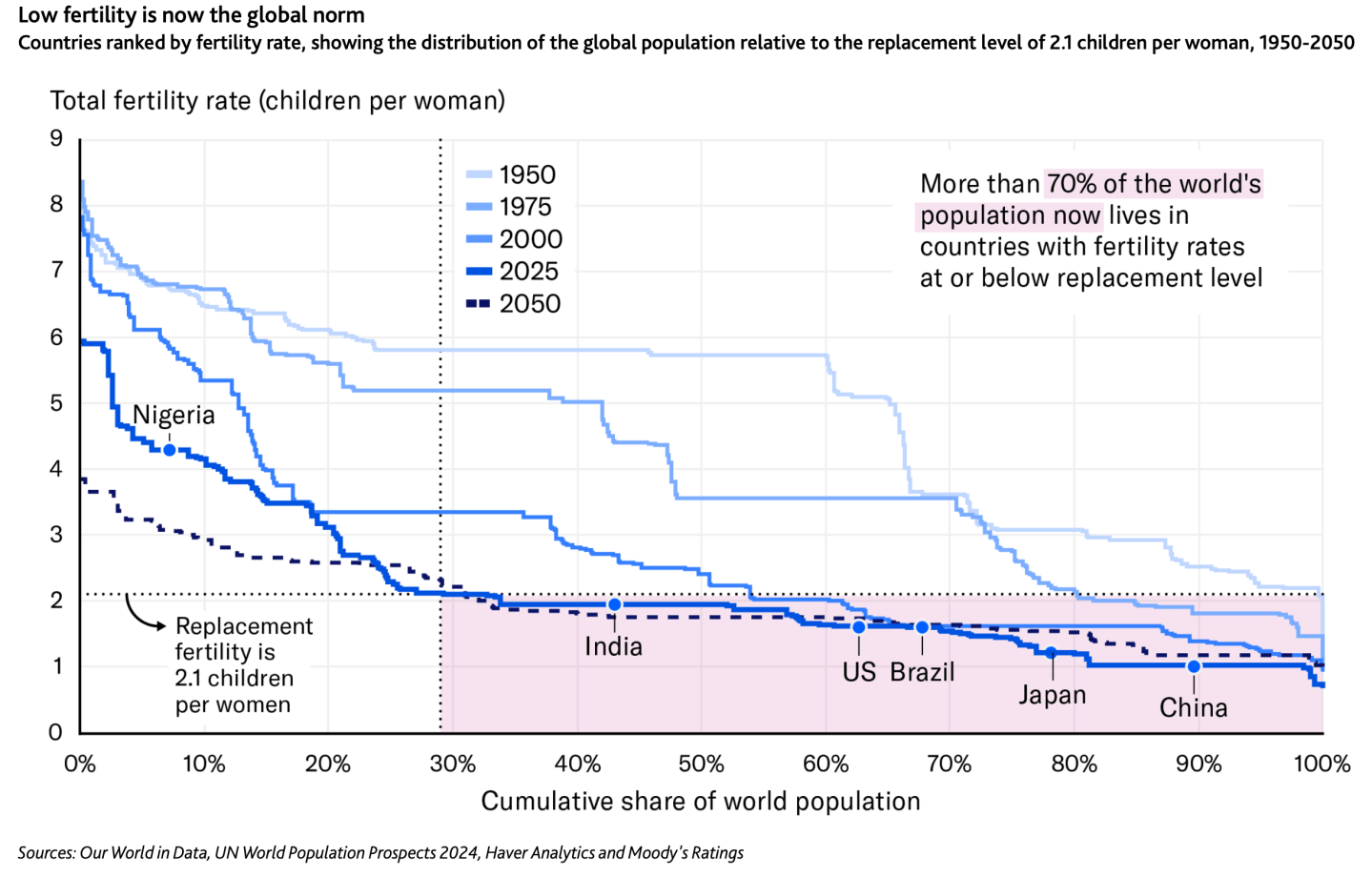
The global fertility rate for humans has never been lower, according to a recent deep-dive into global demographics from Moody’s Ratings.
“The global fertility rate has declined from 4.9 children per woman in 1950 to around 2.2 today, only slightly above the replacement rate of 2.1,” the team there said. “More than 70% of the world’s population now lives in countries with fertility rates at or below replacement level.” In Singapore, the government takes the problem so seriously it has started its own dating service for public employees.
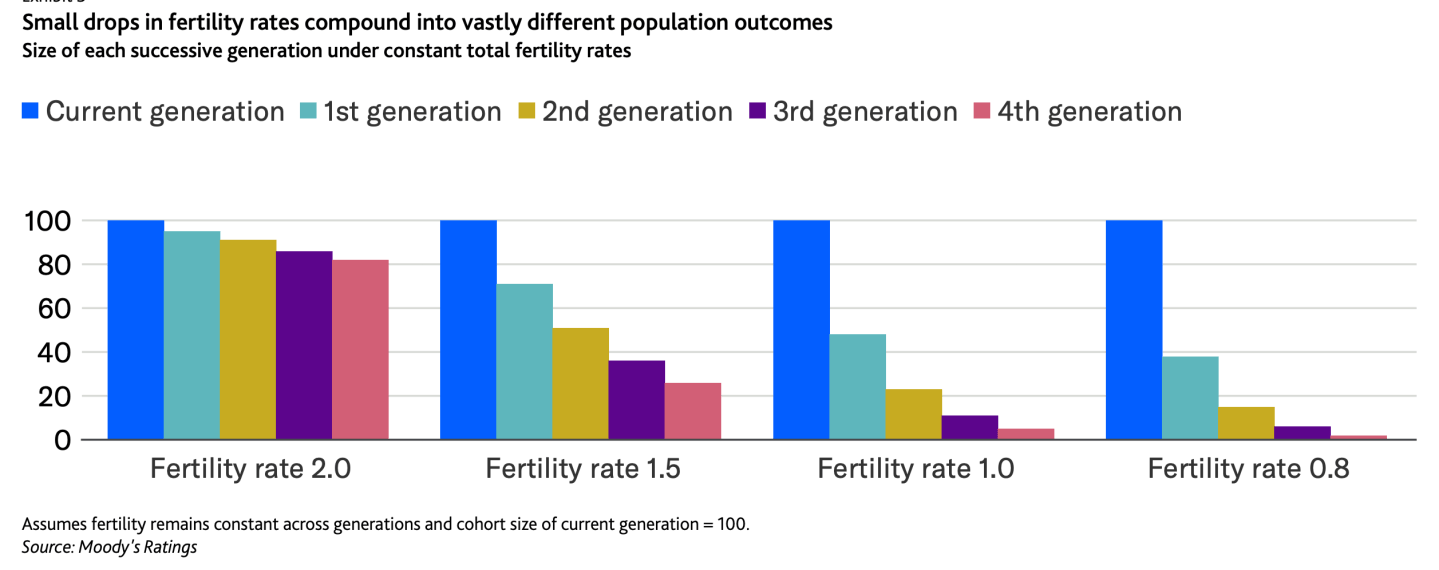
The problem is that birth-rate shrinkage is a compounding problem, Moody’s says: “A fertility rate of 1.0 produces a generation roughly half the size of the one before it. At 0.8, population decline compounds even more rapidly. These effects take decades to emerge but are difficult to reverse.”
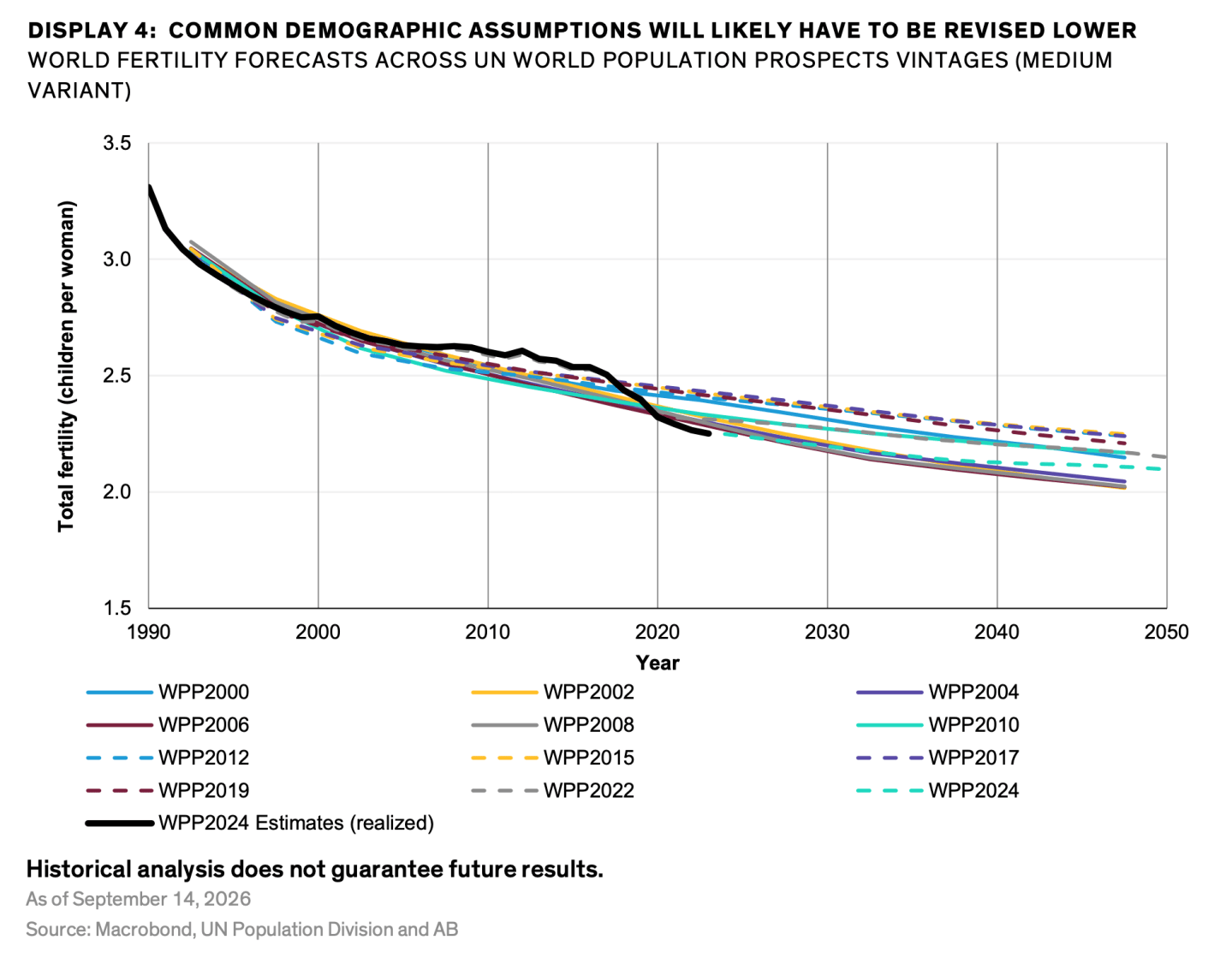
Estimates of future fertility are constantly being revised downward, as this chart from AllianceBernstein shows, implying that the problem is getting worse, faster:
A shrinking population of workers has negative consequences for economic growth, taxes, asset growth, governments’ ability to finance their debt, and inflation, most economists would agree.
Except AB’s Inigo Fraser Jenkins. “It’s probably a controversial view, but we think that fewer babies is actually a good thing. It is too late to curtail a warming of the planet by two degrees, but declining birth rates have broader implications for reducing the wider human impact on the planet and ameliorating the ‘Anthropocene.’ We are also scathing of ethical arguments that more babies are a ‘good.’”
(He and his team promised to elaborate in a forthcoming note.)
THE MARKETS
Stocks rise globally, but U.S. futures signal a pause ahead
- S&P 500 futures were down 0.13% this morning. The index rose 0.73% on Friday.
- In Europe, the Stoxx 600 was up 0.33% in early trading, and the U.K.’s FTSE 100 was up 0.25% before lunch.
- Asia: South Korea’s KOSPI was closed for a national holiday. Japan’s Nikkei 225 was up 2.4%. India’s Nifty 50 was up 0.48%. China’s CSI 300 rose 0.29%.
- Brent crude rose to $102 per barrel.
- Bitcoin was at $85,837.
As the Fed rate rises, gold falls
Gold has largely disappointed investors this year. After rising to around $5,340 per troy ounce at the beginning of the year, it has since lost 21% of its value and sits at $4,197. Gold now seems to be inversely correlated with U.S. interest rates, according to HSBC’s James Steel. If bonds pay higher yields, then gold (which never pays a dividend) makes less sense.
“The financial markets appear to be anticipating more substantial rate hikes, which helps explain recent gold weakness,” he said in a note. “This has been a key factor in reversing gold’s mid-summer rally.”
“As expectations for Fed rate hikes grew, gold prices weakened.”
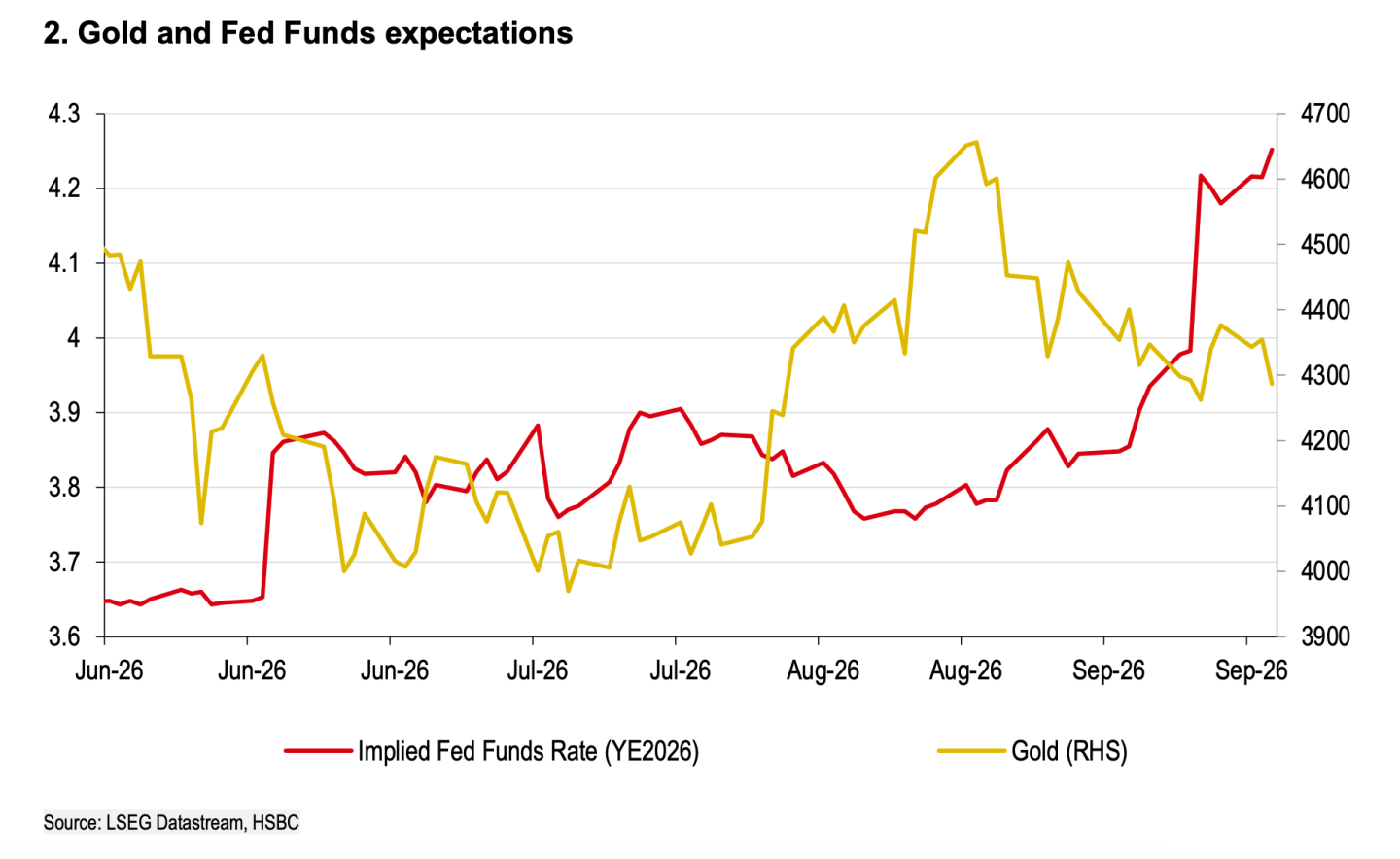
CHART OF THE DAY
AI is killing more jobs than it creates
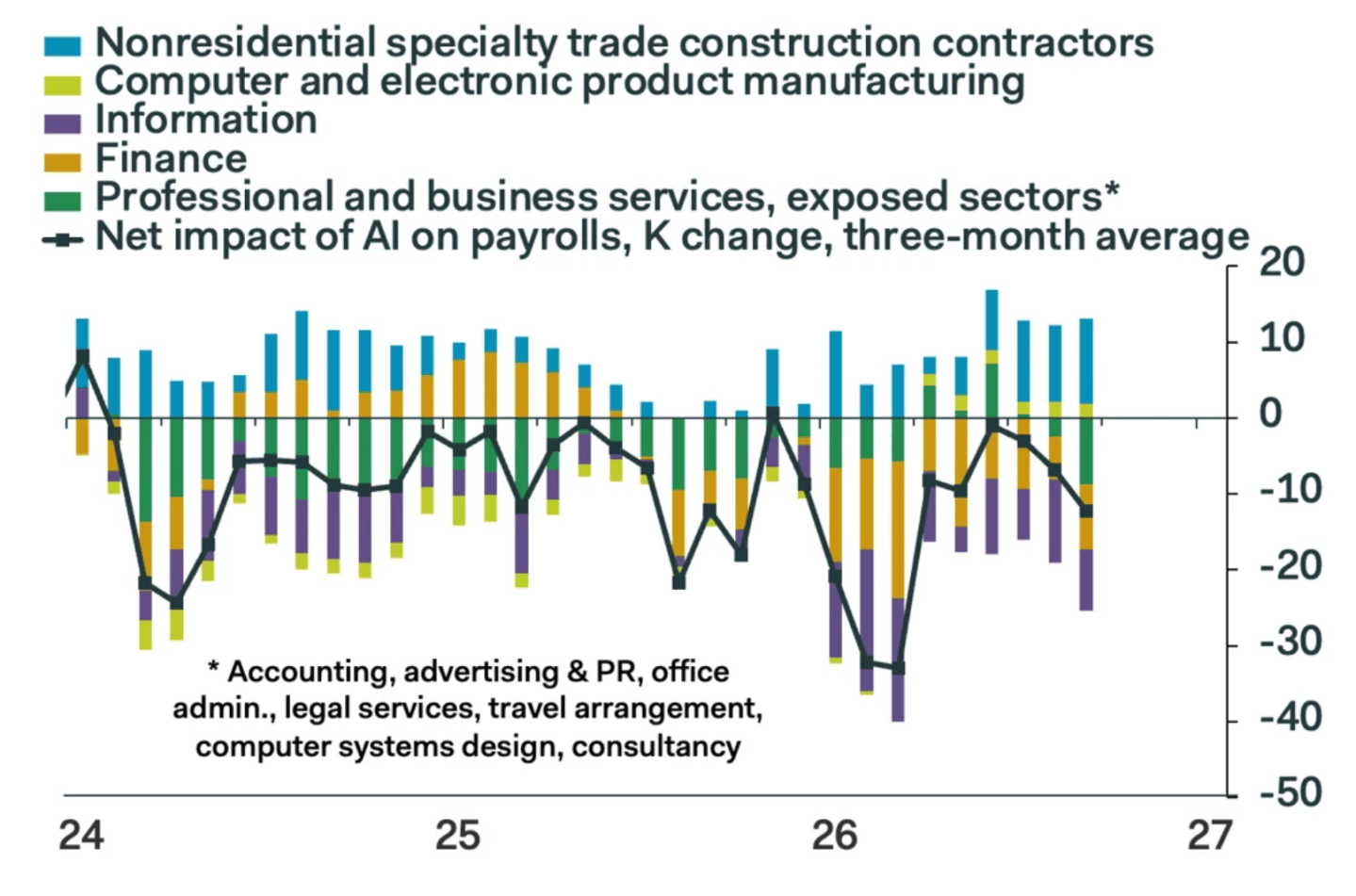
The U.S. delivered a historically weak jobs report on Friday, with the Bureau of Labor Statistics reporting only 29,000 new roles created in September—way below expectations—and the unemployment rate moving up one tenth of a point to 4.2%.
It’s more evidence that AI is nibbling away at the job market, according to Samuel Tombs and Oliver Allen of Pantheon Macroeconomics. Although AI is creating jobs in construction and specialty trades, those gains were offset by larger declines in sectors that are the heaviest adopters of AI, like accounting, advertising, admin, legal, travel arrangement, software, and consulting.
NUMBER OF THE DAY
8.8% of GDP
The amount of revenue needed by the AI sector through 2032 in order to sustain its spending, according to Stijn Van Nieuwerburgh of the Columbia Business School. That’s more than spending on energy, construction, computers, defense, or the internet, the WSJ noted.
THE FRONT PAGES TODAY
U.S. B-1 bombers evacuated from UK base after attack threats from Iran – Axios
Saudi Aramco chief warns world’s oil stockpiles are ‘scarily thin’ – FT
Spending on AI Is becoming almost impossible for businesses to budget – WSJ
Trump tells South Korea to sign on to Alaska LNG deal or ‘I’ll just charge them more’ – CNBC
Spanish prime minister calls snap election after housing protests – BBC
‘Digger,’ Warner Bros.’ last release before merger, is a major flop – NYT
California realtor, 34, busted at LAX on Chinese espionage charges as creepy texts to Beijing handlers revealed: feds – NY Post
ONE MORE THING
The $2.3 billion Etsy witch industrial complex
This summer, with torrential rain threatening her outdoor wedding, a bride did the one thing left on her checklist. She hired an Etsy witch to cast a spell for clear skies. She’s not the only one, according to Fortune’s Tatiana Sataua. Her bridesmaid, Brooke Bekoff, was one of roughly eight bridesmaids, and of those she said five or six had hired Etsy witches for needs of their own.
“I remember that being like, ‘Wait a minute, this is such an interesting opportunity,’” Bekoff said. “There’s really something here culturally.” After the wedding, she built Divina, a marketplace where practitioners offer tarot readings, spell work, Reiki, astrology, and other spiritual services.
The U.S. psychic-services industry generated $2.3 billion in revenue in 2025, according to a July 2025 IBISWorld report, growing at an annualized rate of 5.5%.
As for the bride? The rain continued as she got ready. But then, in a moment Bekoff described as straight out of a movie, the clouds parted right as the bridal party headed outside. Sunlight replaced the downpour, and not a single drop fell during the ceremony until it started to pour again after it ended.
#Sam #Altman #world #accept #bad #happening #benefits #technology