Some of Formula 1’s most populat drivers are already serious about photography. Lewis Hamilton and Lando Norris have both been seen with Leica cameras, and Norris runs a separate Instagram account for his photos.
That overlap goes well past the drivers, or even the intricate pieces that goes into both cars and cameras, says Mike Giannattasio, president of Leica Camera North America.
“There is such synergy between people who collect cameras and people who collect cars,” he told Fortune. “If you see people who are passionate about vintage cars or racing cars, and if they have anything other than a passenger in the seat next to them, eight out of 10 times it’s going to be a Leica camera.”
To Giannattasio, that made a partnership an easy call. On Tuesday, the German camera maker and Formula 1 announced a global licensing deal, Leica’s first official tie-up with the sport. It covers F1 as a whole rather than a single team and includes a special-edition camera, a gallery show in Los Angeles, and events at the United States Grand Prix in Austin this weekend.
‘The decisive moment’
Not everyone saw the workings of a partnership right away. When Giannattasio described the deal to someone he was meeting with, the reply was, “Mike: F1 and Leica? That’s a stretch.”
He disagreed, and his case comes down to how both are made. Car and camera manufacturing both involve intricately crafted pieces put together into something the owner will spend countless hours learning. Each time a shutter fires, and each time a tire squeals, involves countless pieces working together to deliver a smooth outcome.
Leica Camera AG
“When you look at the mechanics of a camera and you look at an M system, inside just a rangefinder, there are over 150 pieces that make the camera work,” Giannattasio said.
An F1 team spends months engineering and testing for a race that can be decided within a fraction of a second. Giannattasio compared that to French photographer and artist Henri Cartier-Bresson’s idea of “the decisive moment,” the instant a photographer has to be ready for.
“Both photography and racing depend so much on preparation,” he said. “While Formula 1 goes at incredible speed, and it may be really hard to stop the moment, photography helps someone who loves that craftsmanship and excellence stop the moment, so that it can be examined, remembered, celebrated.”
Both brands also sell their history. F1 has raced since 1950. Leica still makes film cameras, including the MP and M-A, which have no digital parts.
“You can bring an MP or an M-A into the most extreme weathers in the Antarctic, and because there’s nothing digital, the camera will work,” he said. “It won’t freeze. It won’t break.”
But he said history only counts if it pushes the product forward: “It’s heritage, but it’s not heritage for heritage’s sake,” he said. “It’s heritage for innovation’s sake.”
A camera built ‘in the world of F1’
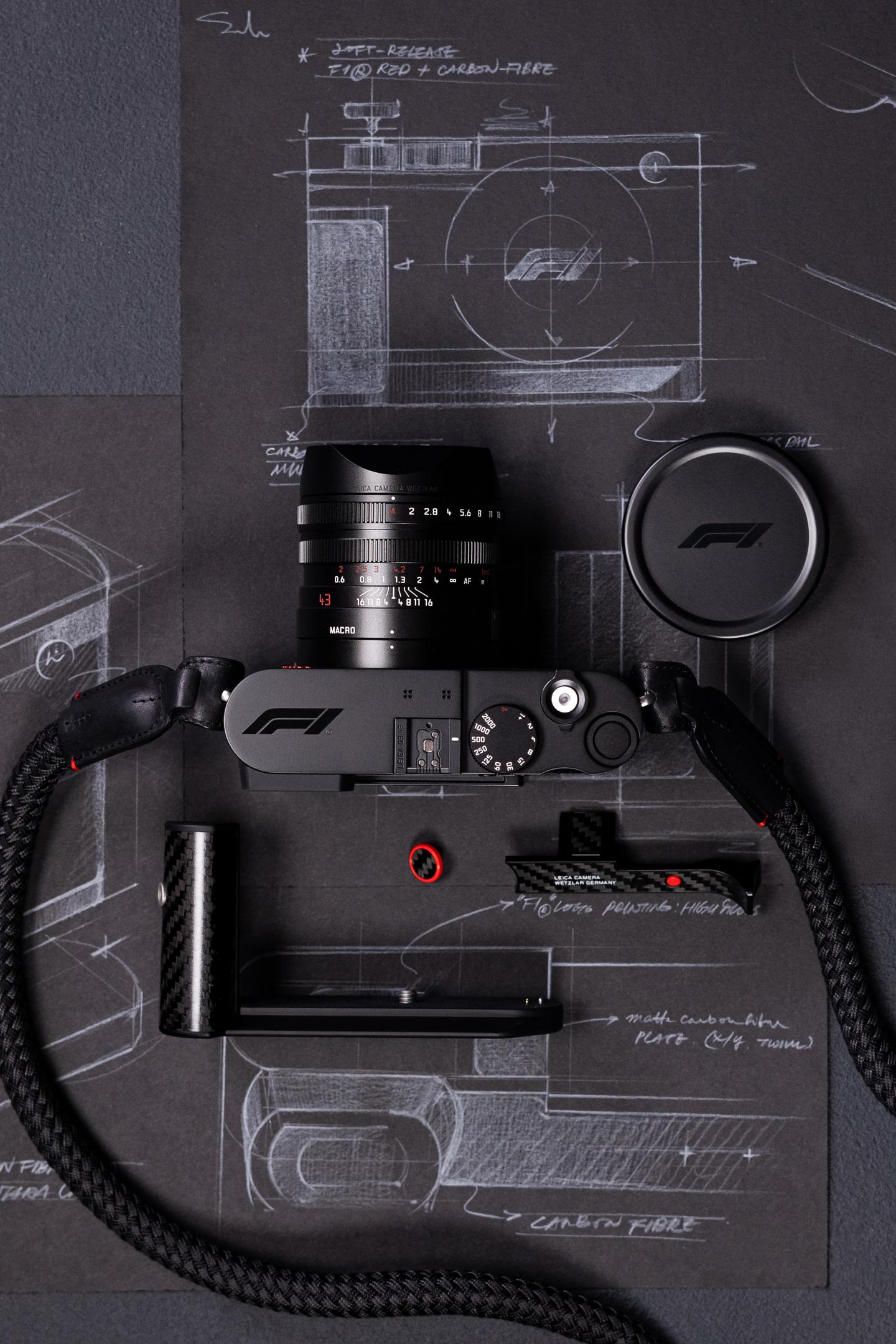
So what goes into making an F1-driver-approved carbon fiber camera? The result is the Leica Q3 43 Formula 1 Edition, which sells for $9,950. It is the first Leica camera to use carbon fiber, the material that defines modern race cars because it is light and rigid. The carbon covers the grip, the thumb rest, and the soft-release button, the spots a photographer touches most.
Giannattasio said the material had to be adapted so the camera still handled the way photographers expect, and that it couldn’t stop looking like a Leica.
“You would ask a little child to draw a camera,” he said. “It’s going to be a rectangular box with a little round circle. It is literally quintessential.”
“We had to make a product that was quintessentially iconic, immediately recognizable as a Leica camera,” he added. “But yet we had to take the design cues and materials that are big in the world of F1.”
The body is wrapped in a black covering modeled on a racing steering wheel, and the red accents on its buttons come from the same place: F1 steering wheels color-code their controls so drivers can find them quickly.
From Montblanc to Leica
Giannattasio, who grew up in Astoria, Queens, came to Leica from luxury goods, not cameras. He spent more than a decade at Montblanc, rising to president and CEO of Montblanc North America, and earlier worked on Christian Dior watches at LVMH. When he interviewed to run Leica’s North American business in 2020, he said, he was likely the only candidate with that background.
“My counterparts were from the electronics or from the camera business and very large companies within that world,” he said.
Once he started, staff kept testing his knowledge of aperture and ISO.
“What I always said to people is, I love art, I love photography, I love culture, and I am here because I’m passionate about building this organization around those principles, not because I am the best photographer who interviewed for the role,” he said.
Despite his résumé, he doesn’t think of Leica as being part of that world: “We don’t by any means consider ourselves a luxury brand. We are a premium brand, meaning we make the best optical equipment in the world.”
What sets Leica apart, he said, is what it asks of the owner. With most luxury brands, money is the only way in. A Leica, he said, also takes time and intellect.
“You need time in order to develop this relationship with your camera,” he said. “While we don’t position ourselves as a luxury brand, what we do in today’s world is quite luxurious.”
He sees that same pull behind a renewed interest in analog products, and he ties it to technology moving faster around us.
“In a world that continues to advance with artificial intelligence, I think [there is a] need to slow down to celebrate and be in the moment,” he said. “Whether it’s film, whether it’s books, whether it’s a writing instrument, there’s a real resurgence for things that are real and deliberate.”
#drivers #carry #Leicas #camera #maker #carbon #fiber #camera