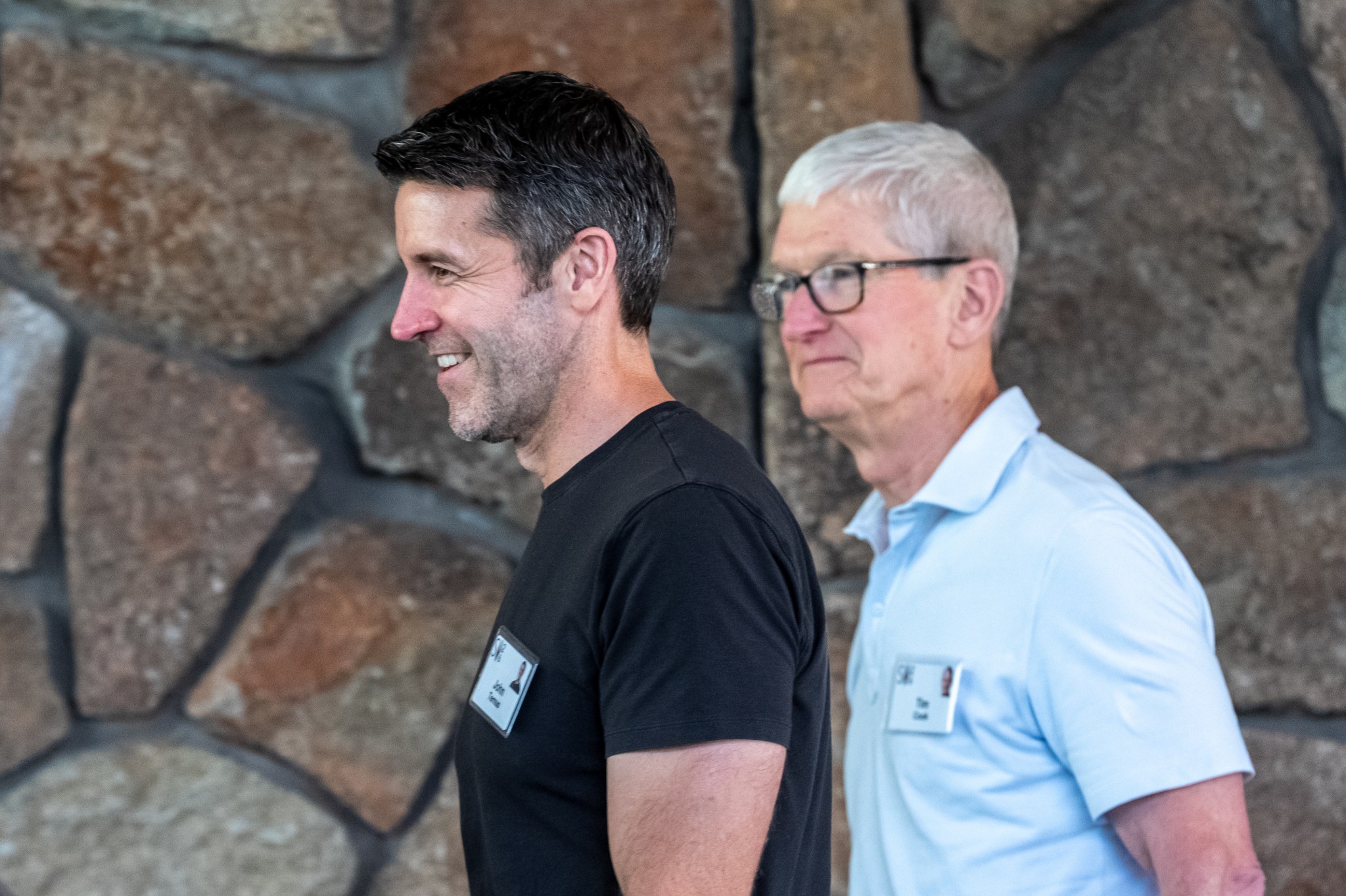
Incoming CEO John Ternus spent years building the credentials that could put him at the helm of Apple: engineering expertise, a record of delivering major products, relationships across the company, and the trust of its top leadership.
Now comes the bigger test: Can he lead one of the world’s most successful companies into its next era of innovation?
In a new Fortune feature, my colleague Sebastian Herrera examines the challenge awaiting Ternus as he prepares to succeed Tim Cook. Cook transformed Apple into an operational powerhouse.
Annual revenue has grown by more than $300 billion since he became CEO in 2011, profits have more than quadrupled, and Apple now has 2.5 billion active devices around the world.
Yet former employees, investors, and analysts say Apple has struggled to produce the kind of category-defining products that marked the Steve Jobs era, as design lost influence and product launches increasingly focused on refining existing hits.
Ternus will inherit that scale as AI reshapes consumer technology and Apple searches for its next generation of breakthroughs.
His career offers a case study in how executives prepare for the top job. Ternus built credibility through hardware engineering and major product launches, played a pivotal role in developing the aluminum 2007 iMac, became a frequent presence in Apple’s design studio, and earned a reputation as an executive who “quietly got shit done.” He also gained exposure to Apple’s most senior ranks through presentations at the company’s annual off-site meeting for its top 100 leaders.
As CEO, his mandate would expand considerably. Former employees and analysts told Herrera that Apple could benefit from the kind of ambitious product development that flourished under Jobs, when small teams challenged assumptions, designers wielded enormous influence, and employees were encouraged to take risks.
As the soon-to-be CEO, Ternus will have the power to build his executive team, elevate talent, shape Apple’s product culture, and determine where the company places its biggest bets.
That makes his ascent particularly instructive for aspiring Fortune 500 CEOs. A record of execution, deep expertise, cross-functional influence, and trust can prepare an executive for the corner office. Once there, the job encompasses setting direction, choosing leaders, empowering experimentation, and creating the conditions for new growth.
Former Apple engineer Matthew Rogers distilled the challenge facing Ternus: “Apple has become the best in the world at iterating. This is about going from iteration to innovation. Those are different skill sets.”
Ruth Umoh
ruth.umoh@fortune.com
Smarter in seconds
Robot revolution. Inside On’s tech lab, where robots build running shoes in 3 minutes and can eliminate up to 300 hours of human work
Rescue mission. How GE CEO Larry Culp pulled off the turnaround of the century
Anxious detachment. Jeff Bezos says being lazy, not working hard, is the root of anxiety
Fortune forgone. A Gen Xer sold his company for $1.6 billion. He kept less than $100 million and gave the rest away because he doesn’t ‘believe in billionaires’
Leadership lesson
JPMorgan CEO on avoiding complacency and bureaucracy: “The way to combat it is always [having] an honest assessment of yourself, not yourself as a person, but your products and service…You’re relentless about it.”
News to know
New tariffs could let Trump lock in long‑term levies without new approval from Congress, using every possible route to push his trade agenda. Fortune
Chinese AI startups Moonshot, Z.AI, and DeepSeek are undercutting leading U.S. labs with comparable models at far lower cost. Fortune
New Fed research shows older millennials are catching up to boomer-level wealth, while younger millennials and Gen Z are increasingly left behind. Fortune
College-educated women are pairing with the highest-earning men without degrees, while non-college women face fewer economically stable partners and much lower marriage rates. Fortune
Billionaire investor Bill Ackman wants to revive the American Dream by giving every American a government-backed stock account. Fortune
United Airlines reportedly explored a megamerger with Delta last year, but after preliminary talks, the idea was quietly dropped. WSJ
Paramount paused its $111 billion Warner Bros. deal amid a looming antitrust battle with states that threatens to complicate the merger. Fortune
Microsoft CEO Satya Nadella’s all‑in AI bet is now under pressure, as a sliding stock, weak Copilot and Xbox performance, and a $190 billion AI build‑out raise doubts. BI
#Apples #CEO #inherits #product #empire #hungry #breakthrough