In 1993, the classic Britpop band Blur closed “For Tomorrow” with a spoken aside: modern life, as far as their narrator was concerned, was rubbish. It became the title of the album and, eventually, shorthand for a certain flavor of Gen X disillusionment—bored, unwilling to take the world’s dysfunction too seriously because taking it seriously wouldn’t change anything.
Three decades later, the generation that Gen X largely raised has inherited the sentiment, minus the irony. The evidence is stacking up across polls, surveys and countless anecdotes that Gen Z isn’t the problem, it’s just that modern life is a bit rubbish. Or, as global advertising firm Ogilvy puts it in its new Gen Z Pulse report: “Gen Z isn’t contradictory. Modern life is.”
The Harris Poll, in a separate survey of 4,100 American adults conducted in late May and early June, found a harsh set of economic conditions that conspire to leave half of the generation lonely every weekend: and that’s because they can’t afford to go out. Nearly three-quarters spend their weekend time at home, and according to the pollster who ran the numbers, the connection between them isn’t psychological, it’s a “spending hangover.”
“We call it placing financial regret over FOMO,” Libby Rodney, Chief Strategy Officer at The Harris Poll, said in an interview with Fortune about the firm’s new Gen Z Weekend Report. “It isn’t the physical connection of things [that Gen Z is trying to avoid], it’s just financial.”
Reid Litman, the director who authored Ogilvy Consulting’s Gen Z Pulse report, sounds similar. “Contrary to how they’re viewed in most media coverage, Gen Zers are not hypocritical or incompetent,” he writes. “They’re navigating new contradictions created by modern life.” Gen Z is, in fact, the first generation to entirely grow up inside a “new reality” as the last decade has progressively shifted “the systems that once carried people through adulthood” onto the individual. “Identity, relationships, and work increasingly blur together,” leaving the youngest generation to do the heavy lifting of figuring it out for themselves.
A generation raised indoors
Rodney argued for a physical component to Gen Z’s loneliness, echoing Litman’s argument that one by one, the structures that previous generations have enjoyed have been removed. Gen Z has spent a childhood spent being funneled toward screens while being locked out of unsupervised physical space, often by the very Gen X parents managing the household.
She cited data showing that 75% of 8-to-12-year-olds are allowed to play on Roblox, while only 25% of the same children are allowed to play unsupervised in their own front yards. That same logic, she argued, followed Gen Z into adolescence: cafes that withhold Wi-Fi, malls that treat teenagers as a shoplifting risk, public space increasingly designed to discourage unmonetized gathering. “They’re really having a hard time connecting in places that aren’t capitalized or monetized around them,” Rodney said. The result, layered on top of a global pandemic that hit during their formative years, is a generation whose default setting became staying in.
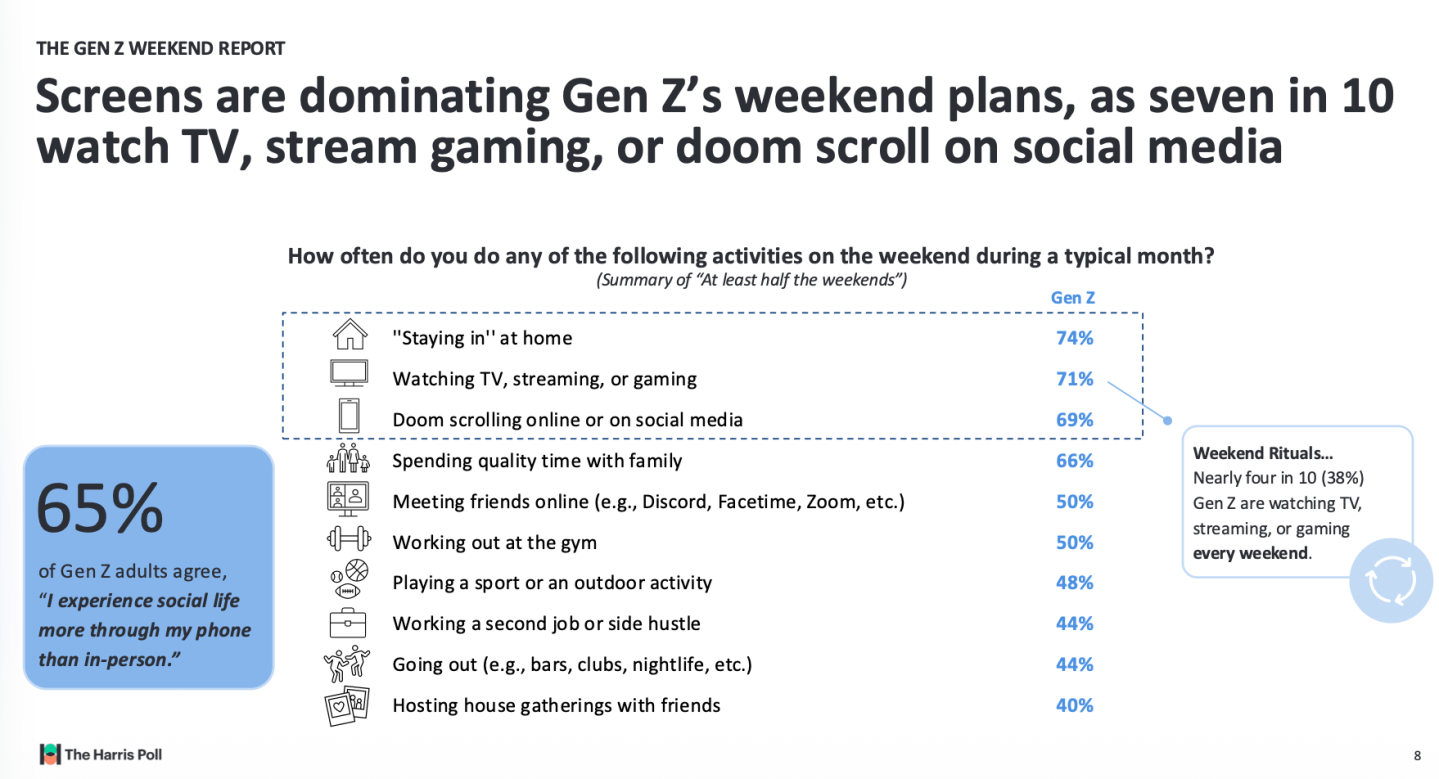
Ogilvy’s data complicates the assumption that this is a screen-preference problem rather than a screen-substitution problem. More than 60% of Gen Zers are actively trying to reduce their own screen time, and 52% say they want more in-person social time—more than they want additional travel, entertainment, or fitness experiences. Yet only 6% say they’re satisfied with their current level of in-person experience, and majorities across all three markets surveyed—58% in the U.S., 63% in the U.K., 55% in Australia—say digital connection helps but in-person time remains essential. The screens aren’t the goal. They’re what’s left after the wallet math fails.
51%: The loneliness number that breaks the curve
The Harris Poll surveyed 603 Gen Z adults as part of a nationally representative sample of 4,100 U.S. adults in late May and early June, and found that 51% report weekend loneliness—the highest of any generation and 37 percentage points above Boomers at 14%. Rodney doesn’t treat that number as an isolated mental-health statistic. “When you read it, you understand they are under a lot of financial pressure, but also just the social implications of that is really sad,” she said. “When a generation is under a lot of financial distress, their social connection can also be under massive pressure as well.”
Ogilvy’s report, meanwhile, was based on 2,100 respondents across the U.S., U.K., and Australia, found that only 17% of young Americans say they feel deeply connected to even one community, and less than 20% say belonging comes naturally to them—75% describe it as something requiring constant, intentional effort.
68%: The wallet math behind the retreat
Sixty-eight percent of Gen Z say going out “isn’t worth the damage it does to my wallet,” and 62% avoid making weekend plans altogether to sidestep the financial regret that follows a night out. At $15 to $25 a drink, Rodney said, “it just becomes impossible to have a weekend that is affordable” — a squeeze compounded by the fact that roughly one in three Gen Z adults still live at home, often specifically to save enough money to move out. Rodney called this figure the clearest evidence that the avoidance is economic, not social: Gen Z isn’t skipping plans because they dislike people, they’re skipping plans because “the spend will hit harder than anything else.”
The clearest illustration, she said, came from a hypothetical question the survey posed: if given an unexpected $100 to spend on a weekend, what would Gen Z do with it? Seventy-one percent said they’d save it or put it toward bills, more than double the 46% of Boomers who said the same. “That is not something that you would see in generations before,” Rodney said. “That is quintessentially, I think, what the research points to.”
That defensiveness tracks with a broader financial mood shift Ogilvy identified globally: half of Gen Z now says it feels financially insecure, up from less than a third just 12 months earlier, according to Deloitte data cited in the Pulse report—one of the fastest-moving sentiment shifts in the entire study.
Why the math is so unforgiving
Just like Litman, Rodney traced the imbalance to a decade of compounding shocks that hit Gen Z simultaneously rather than sequentially. “They are the first ones to get laid off and the least likely to be hired after graduating college,” she said, pointing to inflation and housing costs arriving on top of a rocky entry into the labor market. “Everything is kind of hitting them simultaneously at the same time. They are feeling like they have to be fiscally responsible. And so they’re trading their kind of social connection and their social health for financial health.”
Rodney invoked the phrase popularized by Columbia historian Adam Tooze: “polycrisis,” meaning a stacked series of interlocking crises with no clear solution, running from the pandemic through inflation into today’s labor disruptions. That framing echoes research from Dartmouth economist David Blanchflower, whose 2025 working paper described Gen Z as reinventing the midlife crisis into a “quarter-life crisis,” as previously covered in Fortune. In fact, Rodney said she planned to visit Dartmouth soon, citing the university’s empathetic research on Gen Z, alongside NYU psychologist Jonathan Haidt’s work.
Ogilvy’s respondents describe the pressure in almost identical terms, often explicitly rejecting the idea that their caution reflects laziness rather than economics. When asked about the biggest misconceptions attached to their generation, one 20-year-old woman offered: “Lazy because the affordability of past generations is unattainable to us.”
Another offered: “Not socially smart or financially smart.”
The report frames this as a generation being judged against “a version of adulthood that barely exists anymore” — the same complaint Gen X once had about the systems that raised them, now aimed downward at the systems their own children inherited.
The imbalance isn’t distributed evenly. Forty-two percent of Gen Z renters say they can’t afford to spend money on “fun,” compared with 25% of homeowners, and renters cite saving money as their top reason for staying home at a rate of 58%, versus 41% for homeowners. It also falls harder on women: roughly 41% of Gen Z women say they can’t afford to have fun, compared with a notably lower share of men, a gap Rodney calls a “fun tax” on young women. “There’s also this pressure on young women maybe to be more responsible and have less fun, which kind of stinks,” she said, tying it to broader labor-market disadvantages, including recent research showing young women are disproportionately concentrated in AI-exposed entry-level jobs.
Even the viral-restaurant lines that make Gen Z seem shallow and performative fit this logic: social media has turned dining out into a status ritual, where survey data suggests as many as 84% of Gen Z are actively trying food trends they first see online, and restaurant marketers note that younger diners are heavily guided by what feels current and trustworthy on their feeds. For a generation that largely tells pollsters that eating out is a “treat” rather than an everyday habit, those lines are often the night out itself — a relatively rare, highly curated outing they can document and post — rather than evidence that the rest of their weekends aren’t shaped by brutal wallet math.
Constraint as catalyst, not just retreat
And yet, both Litman and Rodney sounded notes of hopefulness. “It’s so easy to always paint Gen Z in this distressed kind of picture. But they are really thinking about: how do we get out of this?”
Eighty-five percent of Gen Z say they’ve already built workarounds to socialize at lower cost over the past year—hosting friends at home, chasing happy-hour deals, using free fitness-class trials as social outings—and 73% say they want more social settings where alcohol isn’t the centerpiece. Rodney framed that shift as a demand for better value, not less connection: “They want more spaces that ask for less, meaning ask for less money from them and give them more back,” she said, citing hikes and wellness-oriented hangouts as examples where Gen Z leaves “feeling better and not with a hangover, either.”
Ogilvy’s report identifies the infrastructure that’s already absorbing that redirected demand: 42% of Gen Z now find consistent belonging through hobby groups, interest communities, and fandoms—a figure that rivals family (48%) and friends (44%) as a primary source of connection. Run clubs are the clearest example: Strava said the number of run clubs on its platform nearly quadrupled in 2025, with organized events up 50% year-over-year, largely used not to track performance but to find other active people. That pattern directly mirrors the Harris Poll finding that 65% of Gen Z feel more socially connected in wellness-focused settings than in traditional nightlife.
Rodney called Gen Z a “high intent, low budget” generation—one whose thin wallets haven’t diminished its cultural influence. “It would be a mistake to just ignore them because they have low budgets, because they’re high influencers of culture, as youth always have been,” Rodney said, predicting that bars and nightlife venues, not Gen Z, may ultimately be forced to adapt. Ogilvy’s researchers reached a similar conclusion from a different angle, noting Gen Z is projected to lead all generations in spending growth, adding an estimated $9 trillion by 2034—meaning the same generation currently priced out of a Friday night will have its revenge when they inevitably become the dominant consumer force reshaping what socializing looks like next.
It’s a dynamic Rodney also connected to pricing: at $15 to $25 a drink, she said, “it just becomes impossible to kind of have a weekend that is not affordable”—a squeeze compounded by the fact that roughly one in three Gen Z adults still live at home, often specifically to save enough money to move out.
The loneliness figure, in other words, isn’t the end of the story the data tells. Only 6% of Gen Z say they’re satisfied with their current social life, but the same generation is already building the outline of what a less expensive, more sustainable social life could look like.
The clue may have been hidden in Blur’s lyrics all along, because the narrator doesn’t conclude by saying that life is rubbish. Rather, they say they’re “holding on for tomorrow.”
#brutal #math #Gen #lonely #weekends #drinks #driving #generational #spending #hangover